
Bibliographie
Added to library: September 1, 2025
Summary
Here's a comprehensive summary of the provided text, focusing on its content and the reviewer's critical analysis:
The text is a bibliography entry, likely from a journal like T'oung Pao, reviewing several academic works related to Buddhist studies, with a particular focus on Abhidharma. The main works discussed are:
-
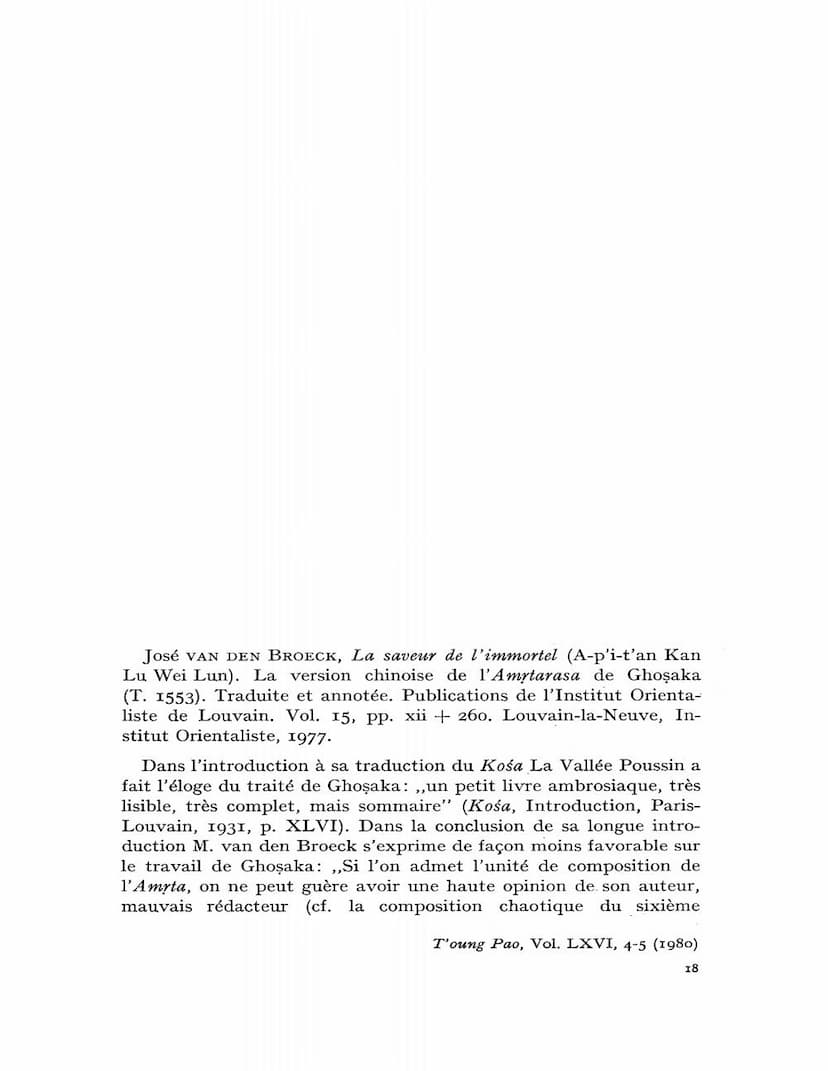
José Van den Broeck, La saveur de l'immortel (A-p'i-t'an Kan Lu Wei Lun). This is a translation and annotation of the Chinese version of Ghosaka's Amṛtārasa, a Buddhist text.
- Core Argument: The review engages with Van den Broeck's assessment of Ghosaka's work. While La Vallée Poussin praised Ghosaka's text as "ambrosial" and "complete," Van den Broeck is more critical, calling Ghosaka a "bad editor" and "poor thinker" due to the text's chaotic composition and internal contradictions. However, Van den Broeck suggests the imperfections might be due to later interpolations or revisions in India or China.
- Relationship to Abhidharmasāra: A significant portion of the review examines Van den Broeck's claim that the Amṛtārasa is an adaptation of the Abhidharmasāra by Dharmasri. The reviewer questions this assertion, noting that while the Abhidharmasāra is considered the oldest Sarvāstivāda dogma, this doesn't automatically make it chronologically prior to or the source for all subsequent works like the Amṛtārasa. The reviewer points out that Van den Broeck's analysis of the central chapters of the Amṛtārasa (2-14) as an adaptation of the Abhidharmasāra's first seven chapters might be flawed, as a detailed comparison shows Ghosaka omitted many topics discussed by Dharmasri. The reviewer also mentions recent Japanese scholarship suggesting the Abhidharmasāra itself belongs to a later period of Sarvāstivāda Abhidharma.
- Authorship: The review strongly supports Van den Broeck's conclusion that the author of the Amṛtārasa cannot be the same Ghosaka mentioned in the Mahāvibhāṣā and Kośa, as their doctrines conflict. This leads to the conclusion that there must have been at least two individuals named Ghosaka, highlighting a common issue of multiple authors sharing the same name in Buddhist tradition.
- Methodological Critiques: The reviewer applauds Van den Broeck's caution in relying on later texts like the Kośa for information about specific schools (Vaibhāṣika, Kashmiri, etc.), noting this prudence is often lacking in Buddhist studies.
- Dating and Translation: The Amṛtārasa was reportedly translated into Chinese during the Ts'ao Wei dynasty (220-265 CE). Van den Broeck suggests the older translation might have been revised based on a 391 CE Chinese translation of the Abhidharmasāra.
- Content Analysis and Corrections: The review praises Van den Broeck's lucid analysis of complex Abhidharma topics (e.g., ten evil paths, cosmology, avijñaptirūpa, Pañcaskandhaka, samskāra, passions, and the path), calling the work a valuable guide. However, it also meticulously identifies and corrects several errors in Van den Broeck's translation and citations, including:
- Misinterpretations of Sanskrit passages (e.g., rasavīryavipākān vs. rasavīryavipākān).
- Incorrect textual readings (e.g., sucikalpikam vs. sucikalpitam, cittāgraha- vs. cittagraha-).
- Bibliography discrepancies (referencing one edition while citing another).
- Misunderstandings of specific terms (e.g., gurukāra vs. gaurava).
- Omissions in explanations (e.g., the need to add "dure ensemble" for saha utpadyante and saha nirudhyante).
- Crucial textual corrections in the explanation of causes for dharma associated with pure thoughts.
- Clarification of the meaning of upanāha (enmity).
- Correction of dharma knowledge object to "consecutive knowledge."
- Refining the interpretation of "consideration of excellent detachment."
- Clarifying the meaning of "they look at the world and make impure what is pure."
- Adding a missing element in the description of subtle matter realms.
- Correcting the definition of satkāyadṛṣṭi (belief in personality).
- Clarifying the meaning of "disgust" as related to the four truths.
-
Almut Netolitzky, Das Ling-wai tai-ta von Chou Ch'ü-fei. This is a German translation of a 12th-century Chinese gazetteer describing Southern China.
- Core Argument: The reviewer praises Netolitzky for undertaking and completing the translation of this important work. Zhou Qu-fei compiled the Ling-wai dai-da after his service in Jinjiang (present-day Guilin) from 1174 to 1177, gathering extensive documentation.
- Source Material: The reviewer notes that Zhou Qu-fei drew from personal observations, local informants, and existing texts, including some dating back to the Tang dynasty and older works like Ji Han's Nan-fang cao-mu zhuang (304 CE). He also was influenced by Fan Cheng-da's work from 1175, revising his own text accordingly.
- Historical Significance: The Ling-wai dai-da is presented as a capital source for the history of the Song dynasty, particularly for Southern China. Its geographical and climatological descriptions, administrative details, and accounts of indigenous populations, customs, and production are considered the best available for the period. The review highlights its descriptions of horse trade with Dali, Vietnamese trade, salt production, and metal exploitation, underscoring the increasing importance of these regions under the Southern Song. It also details China's foreign relations and exotic products.
-
Brief mentions of other works and critiques: The bibliography also includes brief reviews or notes on other scholars' works, often offering corrections or supplementary information. For example, there's a critique of Prof. Lévy's work on dramatic adaptations and mentions of articles by Alsace Yen. There's also a note on the Dutch translation of a hua-pen (story text).
The overall tone is academic and critical, with the reviewer meticulously examining the accuracy, methodology, and historical claims of the works under review. The critique of Van den Broeck's translation is particularly detailed, offering numerous specific corrections and alternative interpretations.