
Bhrngara In Sanskrit Literature
Added to library: September 1, 2025
Summary
This document, "Bhrngara in Sanskrit Literature" by Albrecht Wezler, is an academic exploration of the Sanskrit term "bhrigara," primarily focusing on its meaning and usage in ancient Indian literature.
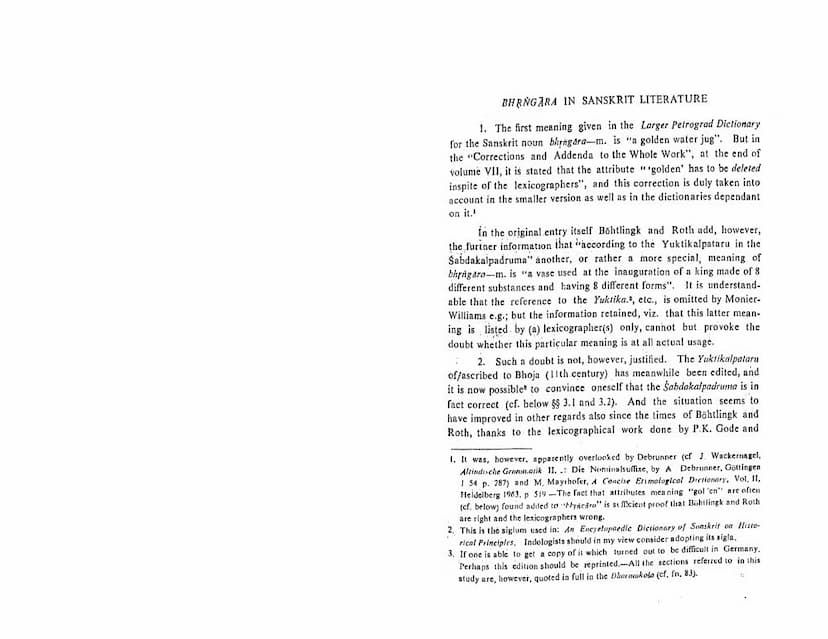
The author begins by addressing the etymological and lexicographical understanding of "bhrigara," noting the initial definition as a "golden water jug" in dictionaries like the Larger Petrograd Dictionary. However, he highlights the debate surrounding the inclusion of "golden" as an attribute, suggesting it might not always be accurate and that the term signifies a specific type of vase or jug. He also points out the "Yuktikalpataru" text's definition of "bhrigara" as a vase used in royal inaugurations, made of eight different substances and having eight forms, a definition that initially raised doubts about its actual usage.
The paper then delves into specific literary instances of the word "bhrigara" to ascertain its meaning and function:
- Pratijna yaugandharayana: The author analyzes a verse where a "bhrigara" is mentioned in the context of a king offering hospitality to a minister. He argues that it refers to a drinking vessel or chalice, likely precious, but not necessarily a coronation-specific item.
- Sivabharata: Here, "bhrigaras" are listed among the loot taken during a military campaign, suggesting they were common equipment for officers and soldiers, further distancing the term from an exclusive coronation context.
- Kautilya's Arthasastra: In this text, "bhrigaropagrahin" refers to a servant carrying a water-vessel as part of a dignitary's retinue. The author emphasizes the practical utility of such vessels for daily life and their role as status symbols for high officials, reinforcing the idea that "bhrigara" denotes an ordinary, though likely valuable, drinking vessel.
- Bana's Harshacarita: The text mentions a "bhrigaragrahin" (bearer of a bhrigara) among a prince's retinue, again linking it to practical service and a high social position.
- Pali and Sanskrit Sources (Donation Ceremonies): The author explores the use of "bhrigara" in donation ceremonies, particularly the pouring of water to solemnize a gift. He discusses how the "suvarnabhrigara" (golden bhrigara) is used to pour scented water onto the hand of the recipient, signifying the truthfulness of the donor's promise. This ritualistic use is highlighted as significant.
- Yuktikalpataru (Coronation Context): The author revisits the "Yuktikalpataru's" specific mention of "bhrigara" as an "abhisekapatra" (coronation vessel). He confirms its description as a significant item in royal inaugurations, made of various materials and decorated with precious stones. This section strongly supports the idea that "bhrigara" did indeed have a specific role in royal consecrations.
- Shape and Form: The text discusses the shape of the "bhrigara," drawing parallels with the "Datura" flower and mentioning a "spout similar in shape to the trunk of an elephant" based on interpretations of commentaries and artistic depictions. This suggests a distinct visual characteristic for the vessel.
- Emblem of Royalty: The author argues that the "bhrigara," particularly when made of precious materials and used in specific rituals, became an emblem of royalty, a symbol of kingship akin to the umbrella and chowrie. This is supported by its inclusion in lists of royal paraphernalia ("rajopakaranas") and mentions in texts where it's contrasted with ordinary possessions during times of royal decline.
- Interchangeability with other vessels: The study notes that in later texts, terms like "kalasa," "ghata," and "kumbha" are often used interchangeably with or instead of "bhrigara" in the context of royal consecrations, suggesting a semantic evolution or substitution of terms for similar ritualistic vessels.
In conclusion, Wezler's paper establishes that while "bhrigara" primarily denotes a drinking vessel or jug with potential practical uses, it also held significant ceremonial and symbolic importance in ancient India. It was used in solemn rituals like donation ceremonies and, crucially, served as a significant abhisekapatra (coronation vessel), thus becoming an emblem of royalty. The author meticulously analyzes various literary passages and linguistic evidence to build a comprehensive understanding of this multifaceted term.