
Bhavyas Controversy With Yogacara In Appendix To Prajnapradipa Chapter XXV
Added to library: September 1, 2025
Summary
Here's a comprehensive summary of the provided text, "Bhavyas Controversy With Yogacara In Appendix To Prajnapradipa Chapter XXV" by Christian Lindtner:
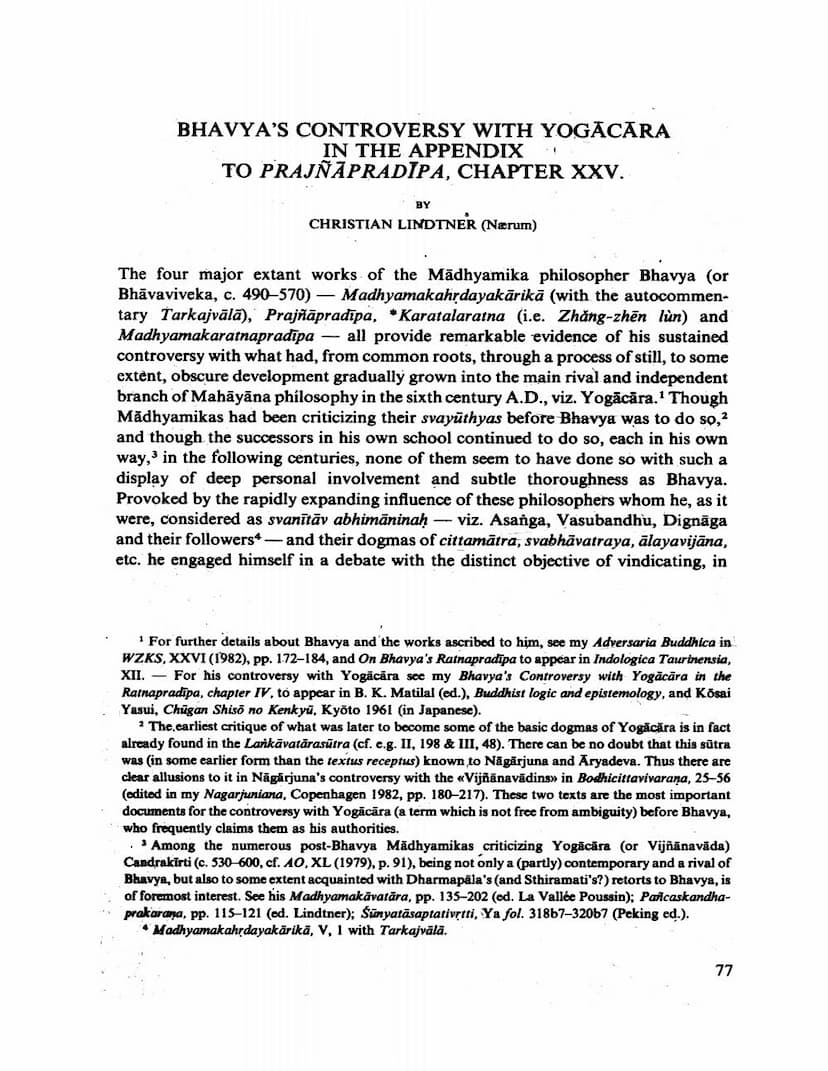
This scholarly article by Christian Lindtner focuses on the significant philosophical debate between the Madhyamika philosopher Bhavya (also known as Bhāvaviveka) and the Yogācāra school of Mahāyāna Buddhism, particularly as presented in an appendix to Bhavya's commentary on Nagarjuna's Prajñāpradipa (PP), chapter XXV.
Bhavya's Significance and His Polemic Against Yogācāra:
- Prominent Madhyamika: Bhavya (c. 490-570 AD) is identified as a major Madhyamika philosopher whose works, including Madhyamakahṛdayakārikā, Prajñāpradipa, Karatalaratna, and Madhyamakaratnapradipa, extensively engage with and critique the Yogācāra school.
- Personal Involvement and Thoroughness: While Madhyamikas had debated rivals before Bhavya, Lindtner emphasizes Bhavya's exceptional personal involvement and detailed argumentation. He saw Yogācāra, with its proponents like Asanga, Vasubandhu, and Dignāga, as a prominent rival that had emerged from common Buddhist roots.
- Goal: Vindication of Madhyamaka: Bhavya's primary objective was to establish the Madhyamaka system, founded by Nāgārjuna, as the fundamentally orthodox form of Buddhism, supported by both scripture (agama) and reason (yukti).
- Historical and Intellectual Interest: The controversy, though somewhat neglected, is deemed historically and intellectually significant for understanding the development of Mahāyāna thought.
Bhavya's Works and Their Critiques of Yogācāra:
Lindtner highlights Bhavya's various works that address the Yogācāra debate:
- Madhyamakahṛdayakārikā (MHK) with Tarkajvālā: This is described as Bhavya's earliest, most extensive, and comprehensive critique.
- Madhyamakaratnapradipa (MRP): This is considered the latest and most mature critique, offering a systematic presentation.
- Prajñāpradipa (PP) Appendix (Chapter XXV): This is the focus of Lindtner's article. It contains a critique of Yogācāra's central dogmas. The Sanskrit original is lost, but the Tibetan version, which Lindtner critically edits here, is preserved.
- Karatalaratna (Talaratna - TR): This work also offers a critique, particularly of concepts like paratantrasvabhāva and tathatā.
All these works, except for the PP appendix, are described as drawing heavily from the MHK and TJ, indicating a substantial dependency on his earlier work, though they also supplement each other. The PP appendix, in particular, shows a clear development in Bhavya's style and presentation.
Core Yogācāra Concepts Critiqued by Bhavya (as presented in PP, XXV):
The appendix to PP, Chapter XXV, engages with specific Yogācāra doctrines:
-
The Three Svabhāvas (Natures): Bhavya critiques the Yogācāra theory of three natures:
- Parikalpita-svabhāva (Imagined Nature): Bhavya argues that this imagined nature, which is a conceptual construction based on language and thought about phenomena, is ultimately empty. He disputes the Yogācāra claim that it is merely a designation and not real in itself. He uses the analogy of mistaking a rope for a snake: the snake is an imagined construct due to mistaken perception, but the rope exists conventionally.
- Paratantra-svabhāva (Dependent Nature): Bhavya questions the Yogācāra assertion that this dependent nature, the basis of conditioned arising and afflicted by ignorance, is conventionally real. He argues that if it is merely dependently originated, it lacks inherent existence and is not ultimately real. He challenges the idea that dependence on causes and conditions grants ultimate reality.
- Pariniṣpanna-svabhāva (Perfected Nature): Bhavya critiques the Yogācāra view of this ultimate reality. He argues that if phenomena are ultimately non-existent, then the concept of their "thusness" (de bzhin nyid) is also not ultimately real. He challenges the notion that this perfected nature is the cause of liberation or that it is a knowable object of wisdom.
-
Critique of Cittamātra (Mind-Only): Bhavya scrutinizes the Yogācāra claim that all phenomena are merely mind (cittamātra).
- Critique of Mind-Only Arguments: He challenges the reasoning used to support this view, such as the argument that external objects do not exist independently because they are perceived by the mind. He argues that if mind-only is the ultimate reality, then the mind itself should be the object of perception, but this is not the case.
- The Role of the Alaya-vijñāna (Storehouse Consciousness): While not explicitly detailed in the excerpt's translation, the critique of cittamātra implicitly involves challenging the storehouse consciousness as the ultimate ground of reality.
- Dependence on Scripture: Bhavya counters Yogācāra interpretations of sutras that support cittamātra, arguing that such passages require further explanation and are not to be taken literally.
-
Critique of Tathatā (Thusness) and Dharmadhātu (Dharmas Essence): Bhavya questions how tathatā or the dharmadhātu can be both pure and impure, as Yogācāra asserts. He argues that if these are truly pure, then afflictions are merely external overlays, and if they are afflicted, then purification would be impossible. He draws parallels to water, gold, and space to illustrate his point.
Bhavya's Method and Assertions:
- Rejection of Ultimate Existence: Bhavya consistently argues that phenomena lack inherent existence (svabhāva).
- Conventional vs. Ultimate Truth: He distinguishes between conventional reality (where things appear and are designated) and ultimate reality (where phenomena are empty of inherent existence).
- Analogy and Reasoning: Bhavya employs analogies (like the rope and snake, illusion) and logical reasoning to deconstruct Yogācāra positions.
- Focus on Emptiness (Śūnyatā): His arguments ultimately aim to demonstrate the emptiness of all phenomena, a core tenet of Madhyamaka.
- Rejection of Yogācāra's "Realism": He views the Yogācāra commitment to some form of ultimate or conventional reality for their conceptual constructs as a failure to fully grasp emptiness.
In essence, Lindtner's article provides a detailed examination of Bhavya's sharp and systematic critique of the Yogācāra school, highlighting Bhavya's crucial role in shaping the Madhyamaka-Yogācāra intellectual landscape in ancient India. The appendix to PP, Chapter XXV, serves as a valuable primary source for this important philosophical confrontation.