
Bhartrharis Familiarity With Jainism
Added to library: September 1, 2025
Summary
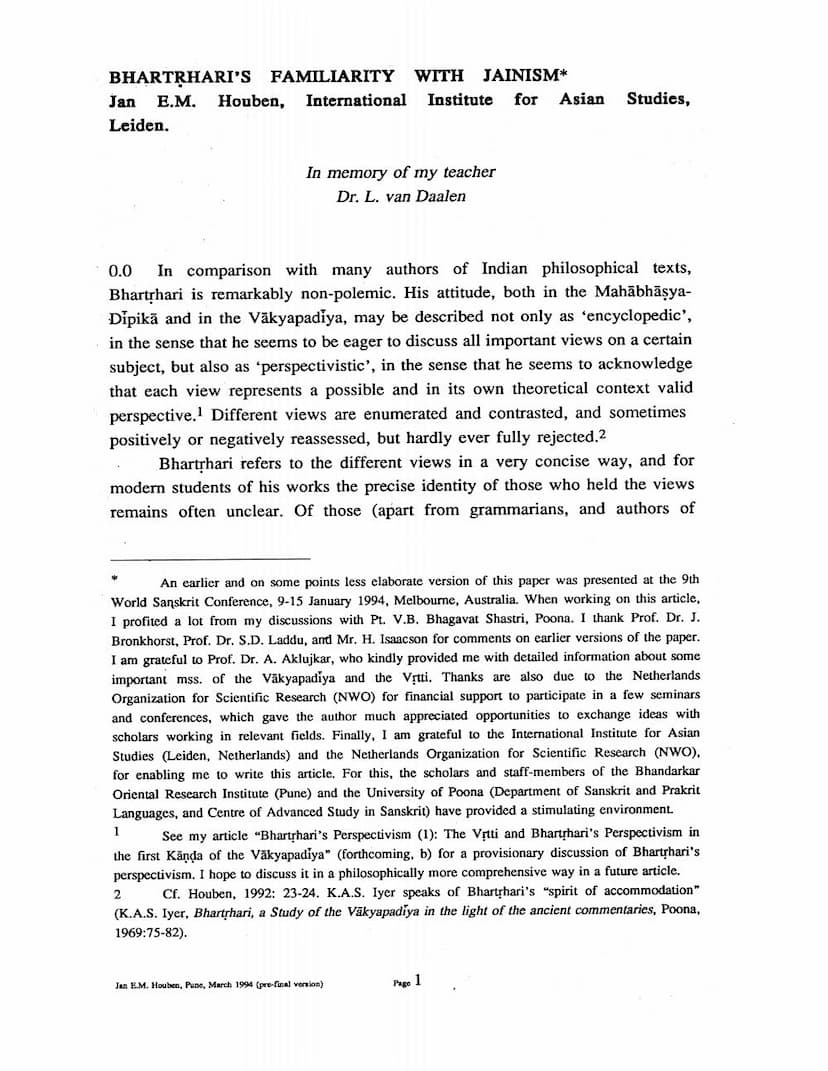
This paper, "Bhartṛhari's Familiarity With Jainism" by Jan E.M. Houben, explores evidence suggesting the renowned Sanskrit grammarian and philosopher Bhartṛhari was knowledgeable about Jainism, a historically significant Indian religious and philosophical tradition.
Houben begins by characterizing Bhartṛhari's philosophical approach as remarkably "non-polemic" and "perspectivistic," meaning he tended to present various viewpoints sympathetically and explore their internal validity rather than outright rejecting them. While acknowledging that Bhartṛhari discussed the views of many Indian philosophical schools, Houben notes that Jainas were not explicitly mentioned by a prominent scholar like K.A. Subramania Iyer. However, Houben posits that Bhartṛhari was indeed aware of Jaina philosophers and their ideas.
The paper then delves into specific passages from Bhartṛhari's major works, the Mahābhāṣya-Dipikā (MBD) and the Vākyapadiya (VP), to support this claim.
Key Arguments and Evidence:
-
Explicit Reference to "Followers of the Arhat": The MBD (1:19.11) explicitly mentions the "followers of the Arhat" in the context of discussing permanence. Bhartṛhari states that these followers, along with Mimāmsakas, do not believe in the destruction of elements like heaven, earth, and space. This aligns with Jaina cosmology, which posits the permanence of the universe (composed of substances like dharma, adharma, ākāśa, pudgala, and jiva) despite constant change within them, as described in texts like the Tattvārthasūtra (TS).
-
Discussion of Prākṣta and Prakṛti: Houben analyzes a passage in the MBD (1:16.28-29) that discusses the permanence of prākṣta words. While the exact meaning of prākṣta is debated, Houben suggests that a significant interpretation, supported by later Jaina commentator Namisādhu, posits prakṛti as the natural, unrefined speech of common people, from which prākṣta (Prakrit) languages derive. This view contrasts with the idea of Sanskrit as the original and pure language. The Vākyapadiya-Vrtti also presents a similar view in its commentary on VP 1.182, where prākṛta words are described as arising from a prakṛti and later modified into Sanskrit by those with "impaired understanding." This perspective, which elevates Prakrit and critiques Sanskrit as a corrupted form, is presented as compatible with Jaina linguistic attitudes and their emphasis on the naturalness of their canonical language (Ardhamāgadhi, and later Sanskrit in their own grammars).
-
Atomism and Sound: The paper examines VP Kāṇḍa 1, verses 1.110-114, which discuss the origin of sound. One view presented is that atoms transform into sound. Houben argues that the description of these atoms and their transformation into sound in the Vākyapadiya-Vrtti closely resembles the Jaina understanding of pudgala (matter) as described in the Tattvārthasūtra. Specifically, the Jaina view of undifferentiated atoms combining into various forms, including sound, aligns well with the Vrtti's explanation, leading Houben to suggest that this likely refers to the Jaina doctrine.
-
Reference to Jainendravyākaraṇa: A significant portion of the paper is dedicated to analyzing two kārikās in the second Kāṇḍa of the Vākyapadiya (VP 2.40 and 2.444). These kārikās discuss how a single phoneme can represent a whole sentence's meaning. Houben argues that the Vrtti's commentary on these verses, with its mention of the technical term samprasāraṇa and its possible corruption into bha or bhi, strongly points to a reference to a specific technicality in the Jainendravyākaraṇa (JV). The JV, an early Jaina Sanskrit grammar, replaces Pāṇini's term samprasāraṇa with the single phoneme ji. Houben suggests that the Vrtti's reference to bha or bhi is a corruption of the intended ji, and that this demonstrates Bhartṛhari's familiarity with Jaina grammatical literature.
Conclusion:
Houben concludes that Bhartṛhari was demonstrably aware of Jaina philosophical and linguistic traditions. His explicit mention of "followers of the Arhat" and the thematic parallels in his discussions of permanence, language, and the nature of sound strongly suggest a familiarity with Jaina thought. The most compelling evidence, according to Houben, lies in the potential reference to the Jainendravyākaraṇa, indicating an engagement with Jaina grammatical innovations. This familiarity broadens our understanding of Bhartṛhari's intellectual world and his "encyclopedic" and "perspectivistic" approach to philosophy, suggesting that his thought may have been influenced by, and in turn influenced, Jaina thinkers. The paper concludes by noting the contrasting anonymity of Jaina references in the Vākyapadiya-Vrtti compared to the MBD, suggesting the Vrtti might not be by Bhartṛhari himself.