
Bhartrhari And Mimamsa
Added to library: September 1, 2025
Summary
This document, "Bhartrhari And Mimamsa" by Johannes Bronkhorst, explores the relationship between the philosopher and grammarian Bhartrhari and the Mimamsa school of Indian philosophy. The core argument is that while Bhartrhari was acquainted with Mimamsa, his primary source of inspiration for understanding ritual details was not Mimamsa itself, but rather the ritualistic traditions of his own Vedic school, likely the Maitrayaniyas.
Here's a breakdown of the key points:
1. Bhartrhari's Engagement with Ritual Details (Uha and Adhrigu Mantra):
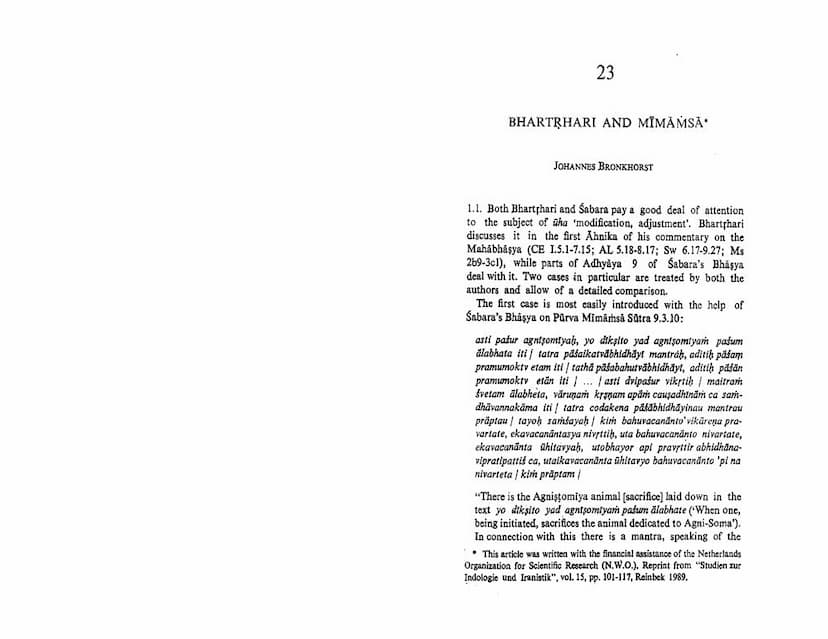
- Uha (Modification/Adjustment): The author highlights that both Bhartrhari and Sabara (a key Mimamsa commentator) extensively discuss the concept of uha, which involves adapting mantras or ritual elements to fit different ritual contexts.
- The "Paśa" Mantra Case: A detailed comparison is made of how both scholars handle a specific mantra related to a "noose" (paśa).
- Sabara, representing the Mimamsa viewpoint, ultimately concludes that both singular and plural forms of the word paśa in the mantra need to be modified into a dual form to match the sacrificial context.
- Bhartrhari, on the other hand, discusses a position that is close to one rejected by Sabara. This position advocates for using the plural form pāśān without modification, and excluding the singular form paśam. This stance is attributed by Bronkhorst to a specific Vedic school (Maitrayaniya) rather than a Mimamsa tenet.
- The Adhrigu Mantra: Bhartrhari also analyzes the adhrigu mantra, another ritual passage. His discussion shows a clear influence from the Manava Srauta Sutra, a ritual text, rather than from Mimamsa. He directly references sections on uha within this Srauta Sutra.
- Sunaskarnastama Sacrifice: Bhartrhari uses the Sunaskarnastama sacrifice as an illustration for a ritual concept. Bronkhorst notes that while Sabara also discusses this sacrifice, his reasoning and explanation differ significantly from Bhartrhari's, again pointing to Bhartrhari's reliance on his own tradition.
2. Bhartrhari's Sources and Independence from Mimamsa:
- Vedic School Tradition: The author strongly suggests that Bhartrhari's detailed knowledge of ritual matters stemmed from "Prayoga manuals" belonging to the Maitrayaniyas, his Vedic school. These manuals were practical guides for performing rituals.
- Absence of Direct Mimamsa Influence in Ritual Analysis: Crucially, Bronkhorst argues that Bhartrhari's discussions on ritual details, unlike his philosophical or grammatical discussions, do not show direct influence from Sabara's Mimamsa Bhasya.
- "Uha Prakarana": Bhartrhari's references to the "section on modification" (uha prakaraṇa) of the Manava Srauta Sutra further solidify his connection to ritualistic texts independent of Mimamsa.
3. Bhartrhari's Acquaintance with Mimamsa:
- References to Mimamsa: Despite his reliance on Vedic school traditions for ritual analysis, Bhartrhari was acquainted with Mimamsa. He uses the term "Mimamsaka" in his Mahabhasya Dipika (commentary on Patanjali's Mahabhasya).
- Shared Concepts (with differences): Bhartrhari mentions views attributed to Mimamsakas, such as the idea that certain things have no destruction. He also discusses eternality of words in a way that reflects a Mimamsa sutra, but with his own unique phrasing, suggesting he engaged with Mimamsa literature.
- Possible Mimamsa Source: Bronkhorst posits that Bhartrhari likely used an early Mimamsa work that contained verses, possibly Bhavadāsa's Vrtti. This work, not being Sabara's Bhasya, explains why Bhartrhari might present ideas that differ from Sabara's interpretations.
- Older Mimamsa Views: Bhartrhari's commentary indicates familiarity with an older Mimamsa view where sacrifice itself constitutes dharma, contrasting with Sabara's view that the rituals produce dharma. This further supports the idea that Bhartrhari was familiar with Mimamsa texts that predated or differed from Sabara's.
4. Conclusion:
Johannes Bronkhorst concludes that Bhartrhari was not a Mimamsa scholar in the way Sabara was. While he knew of Mimamsa, his engagement with ritualistic practices was rooted in the traditions of his Vedic school, the Maitrayaniyas. His understanding of ritual, particularly uha, was informed by ritual manuals and Srauta Sutras rather than solely by Mimamsa hermeneutics. His interaction with Mimamsa was more in the realm of philosophical or grammatical arguments, potentially through earlier Mimamsa texts like Bhavadāsa's Vrtti.
In essence, the book argues for Bhartrhari's significant scholarship in Vedic ritual, highlighting his independent reliance on his own tradition, while acknowledging his intellectual awareness of the prevailing Mimamsa school.