
Bemerkungen Cu Einigen Van Naturbeobuchtung
Added to library: September 1, 2025
Summary
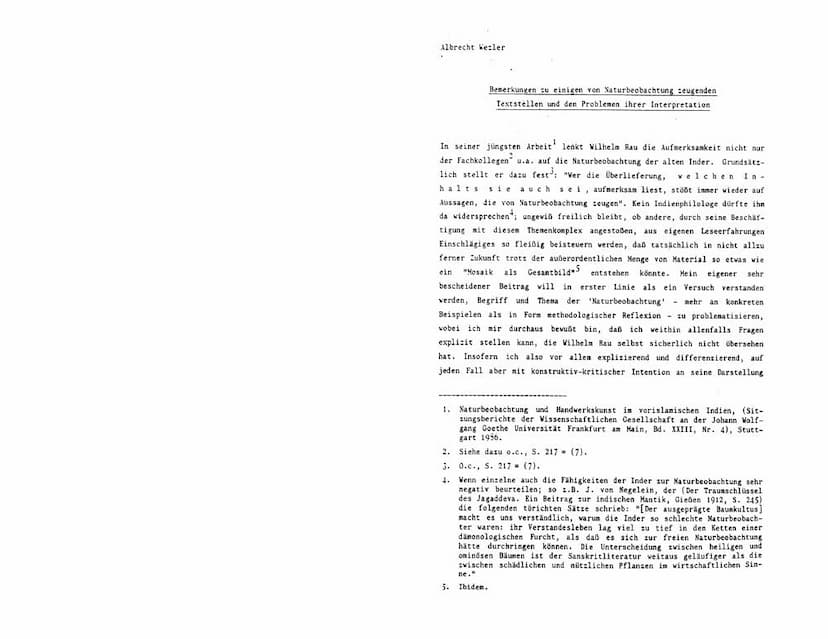
This document is an excerpt from a work titled "Bemerkungen zu einigen von Naturbeobachtung zeugenden Textstellen und den Problemen ihrer Interpretation" by Albrecht Wezler. The text is an academic discussion, likely an essay or chapter, that delves into the complexities of interpreting ancient Indian texts that describe natural observations.
Here's a summary of the key points discussed in the provided pages:
I. Introduction and Setting the Stage:
- Response to Wilhelm Rau: The author, Albrecht Wezler, begins by referencing the work of Wilhelm Rau, who highlighted the presence of natural observations in ancient Indian texts. Wezler agrees with Rau's fundamental assertion that careful reading of any tradition will reveal statements stemming from nature observation.
- Goal of the Essay: Wezler's own contribution aims to problematize the concept and theme of nature observation by using concrete examples rather than purely methodological reflection. He acknowledges that his work will primarily raise questions that Rau himself likely considered.
- Methodology: Wezler intends to build upon Rau's presentation with an explanatory and differentiating, yet constructively critical, approach. He hopes to avoid criticism for not adhering to the unwritten laws of Festschrift contributions.
II. The Intertwined Nature of Observation and Belief:
- No Exclusion of Religious/Philosophical Texts: Wezler emphasizes (by bolding a specific phrase) that no texts, including religious or philosophical ones, should be excluded from the corpus of sources for studying natural observation.
- Examples of Intertwined Concepts:
- Umasvati's Zoological System: Rau points to Umasvati's Tattvarthadhigamasutra which classifies animals based on the number of senses. Wezler notes that Rau connects this to the belief in sentient plants and the transmigration of souls into plant forms, demonstrating how observation is intertwined with philosophical and religious beliefs.
- Patanjali's Mahabhasya: Wezler examines a passage from Patanjali's Mahabhasya regarding the diripa-tree and the suvarcala plant. Rau identifies these as examples of nature observation: the diripa-tree's flower sleeps downwards when closed, and the suvarcala moves with the sun.
- The Problem of "Speculation": Wezler questions whether the "speculative" part of these statements can be separated from the observational "core." He asks if an interpreter can cleanly distinguish between the observed phenomenon (e.g., a flower closing downwards, leaves orienting towards the sun) and the subsequent "speculations" or conclusions drawn (e.g., the flower is "sleeping," the plant "wanders with the sun").
III. Critiquing Interpretations and the Mahabhasya Passage:
- Sivaramendra Sarasvati's Commentary: Wezler introduces a commentary by Sivaramendra Sarasvati on the Mahabhasya passage.
- Suvarcala: Sivaramendra interprets the suvarcala passage as referring to heliotropism (movement in response to the sun) of the plant's flowers, but he doesn't elaborate on the conclusion drawn.
- Diripa: Sivaramendra's explanation of the diripa passage veers into fantastical, magical, or tantric ideas, suggesting the tree itself "sleeps" and that cutting a branch allows one to fly. This raises questions about whether the statement still reflects nature observation.
- Challenges in Interpretation: Wezler highlights the difficulty in accepting Sivaramendra's interpretation of the diripa passage, especially as it relies on a discarded reading of the text. He also notes the differing interpretations of the suvarcala and the debate over identifying the plant with heliotropic properties.
- Scientific vs. Traditional Understanding: The debate about suvarcala highlights the challenges in identifying plants based on descriptions that might be influenced by non-observational factors. Wezler points out the disagreement between different scholars regarding the heliotropic nature of potential identifications.
IV. The Nature of Observation and "Natural Interpretations":
- Broader Implications: Wezler broadens the discussion to the philosophical concept of observation itself. He contrasts the everyday understanding of observation with scientific definitions, which often emphasize recording facts as they appear to perception.
- Protocol Statements: He questions whether statements from ancient Indian texts, even if they describe nature, can be considered "protocol statements" in the scientific sense. This leads to a consideration of the status and character of these textual statements and their relationship to the original observations.
- Feyerabend's Influence: Wezler draws on the ideas of philosopher Paul Feyerabend, who argues that observation statements are formed from a combination of clear perception and linguistic expression. Feyerabend also posits that observation statements inherently contain or acquire theoretical assumptions.
- "Natural Interpretations": Feyerabend uses the term "natural interpretations" to describe "mental operations that attach themselves so closely to the senses that separation is difficult." These are deeply ingrained, often unconscious, conceptual frameworks that shape how we perceive and describe the world.
- Challenges for Indologists: Wezler concludes that the difficulties faced by Indologists in interpreting these texts are not solely due to the material's nature but also to the general problem of observation statements, which are imbued with "natural interpretations." The cultural and intellectual distance from the source material further complicates the task of identifying and understanding these interpretations.
V. The Mahabharata Passage and the Debate on Plant Consciousness:
- Focus on a Specific Text: The author then shifts to a detailed examination of a passage from the Mahabharata (Mokṣadharmaparvan, Adhyāya 177, verses 10-18), which is frequently cited in discussions about the consciousness and sensory abilities of plants.
- The Core Debate: The passage centers on a debate between Bhrgu and Bharadvaja regarding whether plants, like animals and humans, are composed of the five elements and thus possess sensory organs.
- Bharadvaja's Argument: Bharadvaja argues that plants, despite appearing solid, must contain ether because they consistently unfurl leaves and flowers. He also argues that they possess air because they absorb water through their stems and roots, analogous to human breathing.
- Wezler's Analysis of the Arguments:
- Ether and Plants: Wezler scrutinizes Bhrgu's reasoning for the presence of ether, questioning the logic of inferring it from the unfolding of leaves and flowers. He argues that Bhrgu's argument is flawed and that the correct interpretation of verse 10 should focus on the observation of fruits and flowers and the subsequent inference of ether as the space that allows for their manifestation.
- Air and Plants: Wezler also analyzes the argument for the presence of air, which is based on the analogy of human breathing and sucking water through tubes. He corrects a common misinterpretation and argues that the analogy is with how humans suck water through a hollow stem, implying the presence of wind within plants.
- Water and Fire: He briefly touches upon the arguments for water and fire, noting that water absorption is observable, while the inference of fire is based on analogy with human digestion.
- The Role of Analogy: A significant theme that emerges is the pervasive use of analogy to human physiology and experience to understand plant life. The author suggests that the ancient Indian understanding of the five elements in plants is heavily influenced by the assumption of correspondence with human processes.
- Anthropomorphism: Wezler concludes by reflecting on the human tendency to project human experiences and interpretations onto plants, even in modern scientific contexts. He acknowledges that while this anthropomorphism can sometimes facilitate a recognition of plants' rights, it also poses a significant challenge for objective understanding.
In essence, Wezler's article is a scholarly dissection of how ancient Indian texts describe nature, highlighting the challenges in separating observation from interpretation, belief, and ingrained cultural frameworks. He uses specific examples from key texts to illustrate these complexities, emphasizing the need for careful, nuanced, and critical engagement with the material.