
Beating Of Brahmins
Added to library: September 1, 2025
Summary
Here is a comprehensive summary of the provided Jain text, "The Beating of the Brahmins" by Colette Caillat, focusing on Chapter 12 of the Uttaradhyayana-sutra:
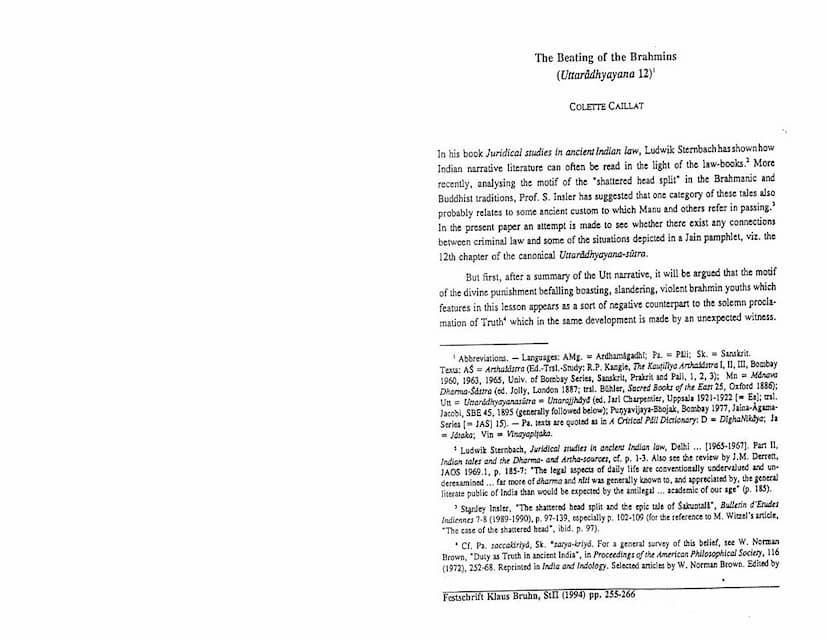
The article by Colette Caillat, "The Beating of the Brahmins," analyzes the twelfth chapter of the Jain Uttaradhyayana-sutra (Utt 12), often referred to as the Harikesabala-adhyayana. Caillat posits that this chapter, a vigorous anti-Brahmanic pamphlet, can be understood in relation to ancient Indian law and customs. The central theme explored is the conflict between a highly virtuous Jain monk, Harikesabala, and a group of traditional Brahmins and their attendants.
Summary of the Narrative in Utt 12:
The core of the narrative revolves around the muni Harikesabala, who, despite being born into a low "svapaka" family, embodies perfect asceticism and restraint. While begging for alms, he encounters Brahmins performing a sacrifice. The Brahmins, filled with pride of birth and societal status, mock and verbally abuse Harikesabala. They even incite their young attendants to physically assault him.
An invisible Yaksha, a divine devotee of Harikesabala, intervenes and declares the monk's chastity and self-control. The Brahmins, however, continue to threaten him. Subsequently, a princess named Bhadra, who had previously been offered to Harikesabala and refused due to his asceticism, steps in. She publicly testifies to his unwavering chastity and virtue, serving as a powerful witness.
In response to the continued aggression and the Brahmins' arrogance, the Yakshas appear with fearsome forms and violently beat the Brahmin youths, causing them severe injuries. The punishment inflicted by the Yakshas mirrors the violence previously perpetrated by the youths. Later, the Brahmin teachers, witnessing the severe suffering of their attendants and recognizing Harikesabala's superiority, humbly apologize and ask for forgiveness for their ignorance and the actions of their disciples.
Key Arguments and Connections:
-
Divine Punishment as a Negative Counterpart to Truth: The narrative presents the violent punishment of the boastful, slandering, and violent Brahmin youths as a "negative counterpart" to the solemn proclamation of Truth made by Bhadra. Her "Act of Truth," based on her personal knowledge of Harikesabala's virtue, effectively disarms the aggressors' wrath.
-
The Incompatibility of "Brahmanhood": The fundamental conflict stems from the Brahmins' superficial understanding of "Brahmanhood," rooted in birth and social status, versus Harikesabala's embodiment of true Brahmanical qualities like non-violence, self-control, and chastity. The Brahmins, despite their claims to religious authority, are depicted as violent, undisciplined, and proud, negating the very essence of what they profess.
-
Echoes of Ancient Legal and Social Practices: Caillat draws parallels between the offenses and punishments depicted in Utt 12 and ancient Indian legal texts like Manu (Mn) and the Arthaśāstra (AS).
- Verbal and Physical Injury: Both texts address verbal injury (defamation, vilification, threat) and physical injury (striking). In Utt 12, the Brahmins commit both types of offenses, and their attendants carry out the physical assault.
- Talion Law and Punishment: While the law books often prescribe fines, Caillat notes instances where punishments could involve bodily harm, particularly against those of lower status attacking higher status individuals. The narrative in Utt 12, where the youths are beaten after assaulting Harikesabala, reflects a form of retributive justice, potentially hinting at the survival of ancient practices where divine intervention (like that of the Yakshas) meted out severe penalties, especially for Brahmins who were often beyond secular law.
- The Role of Witnesses: The importance of witness testimony is highlighted, with Bhadra, a woman, playing a crucial role. Despite societal norms potentially limiting a woman's testimony in ordinary matters, her personal knowledge of Harikesabala's conduct makes her testimony valid and effective in this context.
- "Acts of Truth" (Satyakriya): The narrative aligns with the ancient Indian belief in the power of Truth. Bhadra's declaration, based on Harikesabala's perfect virtue, functions as an "Act of Truth" that can achieve miraculous results, such as pacifying anger. This concept is also found in other Indian traditions.
-
Comparison with Buddhist Texts: The article also briefly compares Utt 12 with the Buddhist Matanga Jataka, noting similar thematic elements: a virtuous outcast challenging Brahmins and facing their aggression, leading to divine retribution. Furthermore, it touches upon the Buddhist concept of the "fourth parajika" (an offense involving defeat) related to monks falsely claiming spiritual attainments. This is likened to the Jain emphasis on the dangers of pride and false claims, which can undermine the established hierarchy within religious communities.
-
The Paradox of Hierarchy: The story highlights a paradox where the victim (Harikesabala), from the lowest social group, is infinitely superior in true spiritual hierarchy to his aggressors from the highest social rank. While the Brahmins' actions are socially reprehensible, the narrative framework for fighting them must still, to some extent, conform to existing societal and legal principles, even as it ultimately subverts the commonly accepted social order through spiritual truth and divine intervention.
Conclusion:
Caillat concludes that Utt 12, while seemingly a simple polemical text, offers valuable insights into the interplay between religious beliefs, social structures, and legal frameworks in ancient India. The narrative, though vivid and dramatic, reflects an underlying understanding of justice, virtue, and the societal hierarchy that, while challenged, remained a fundamental organizing principle. The "beating of the Brahmins" serves as a narrative device to illustrate the consequences of pride, the importance of true asceticism, and the potent force of spiritual truth in a society deeply structured by social status.