
Author Of Three Centuries
Added to library: September 1, 2025
Summary
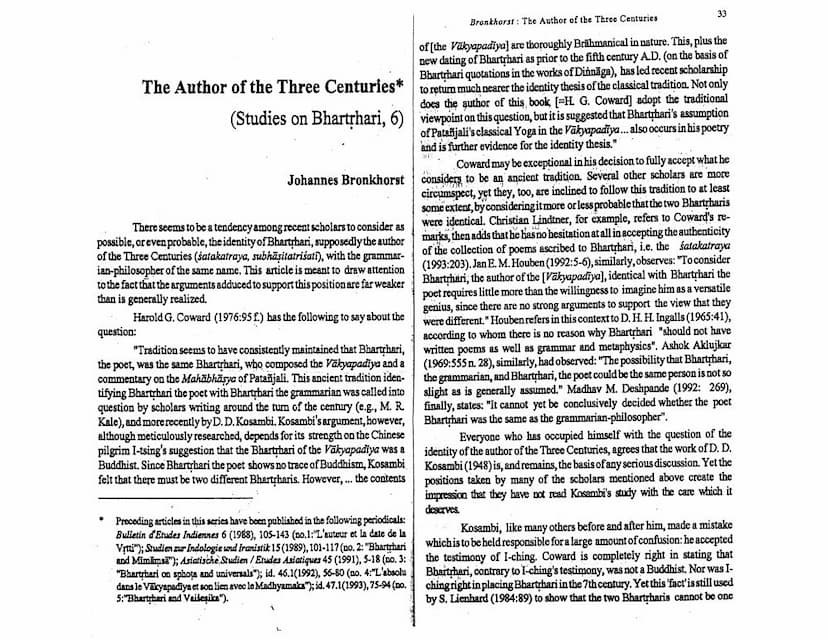
Here's a comprehensive summary of the provided text from Johannes Bronkhorst's "The Author of Three Centuries," focusing on the arguments presented against the traditional identification of the poet Bharthari with the grammarian-philosopher Bharthari:
The article "The Author of Three Centuries" by Johannes Bronkhorst critically examines the prevailing scholarly tendency to identify the author of the Śatakatraya (Three Centuries) with the renowned grammarian-philosopher Bharthari. Bronkhorst argues that the evidence supporting this identity is significantly weaker than commonly acknowledged.
Critique of Current Scholarly Consensus:
- Bronkhorst notes that scholars like Harold G. Coward, Christian Lindtner, Jan E. M. Houben, Ashok Aklujkar, and Madhav M. Deshpande tend to accept, or at least consider probable, the identity of the two Bhartharis.
- He contends that many of these scholars rely on outdated or misinterpreted arguments, particularly the testimony of the Chinese pilgrim I-tsing.
Deconstructing the I-tsing Argument:
- I-tsing suggested that the author of the Vākyapadīya (the grammarian-philosopher) was a Buddhist. Since the poet Bharthari shows no Buddhist leanings, D. D. Kosambi used this to argue for two different individuals.
- Bronkhorst agrees with Coward that Bharthari the poet was not Buddhist, and I-tsing was also incorrect about Bharthari's dating (placing him in the 7th century).
- However, Bronkhorst emphasizes the need to disregard I-tsing's unreliable testimony altogether, as it has led to considerable confusion.
Challenges to the Śatakatraya's Authorship and Authenticity:
- Variability of the Text: Bronkhorst highlights Kosambi's observation that the Śatakatraya exists in highly variable manuscripts, with numerous stanzas appearing in different orders or not at all. Only about 200 of the 850 stanzas are common across all manuscripts. This suggests the work was compiled long after the supposed author's death, with continuous accretion of verses.
- Original Collection's Integrity: This variability leads to the fundamental question of whether even the original kernel of the Śatakatraya had a single author. Bronkhorst suggests it's more likely that the original collection was an anthology from its inception.
- Presence of Verses from Other Authors: Several verses in the identified kernel of 200 stanzas are found in other early texts, such as Kālidāsa's Abhijñānaśakuntala and the oldest layer of the Pañcatantra.
- Dating Conflict: Kosambi concluded that if these verses were indeed by one person, that person must have lived before Kālidāsa and the Pañcatantra. This directly conflicts with the dating of the grammarian-philosopher Bharthari, who, based on evidence like the Candra-vṛtti citing Kālidāsa and the Vākyapadīya-vṛtti referring to Candra (who lived after Kālidāsa), likely lived after Kālidāsa. This creates a dilemma: either the Śatakatraya's kernel had a single author other than the grammarian Bharthari, or the Śatakatraya was an anthology from the start.
Critique of Arguments for Homogeneity and Unity:
- Warder's Argument: While A. K. Warder argues for a homogeneous "philosophical" outlook in the Śatakatraya, suggesting an individual author, Bronkhorst counters that a collection can present a homogeneous outlook even with multiple authors. Kosambi himself noted the similar "total impression" despite textual variations, implying a "certain type of stanza came to be attracted to the collection."
- Sternbach's Argument: L. Sternbach's claim of a "definite unity of structure" in the Śr̥ṅgāraśataka is dismissed as ill-founded. Bronkhorst points out that Sternbach's argument relies on a specific order of verses, which is notoriously absent in many manuscripts, and he doesn't specify which version he refers to.
Weakness of Attributive Evidence:
- Late Attribution: The evidence attributing the Śatakatraya to a poet named Bharthari is described as "meagre and late." Mentions by Somadeva (10th century) and Merutuṅga (14th century) are cited, but the 14th century is over eight centuries after the probable dating of the grammarian.
- Lack of Ancient Tradition: Bronkhorst challenges Coward's notion of an "ancient tradition" consistently maintaining the identity. K. A. S. Iyer notes that the tradition is recorded in Ramabhadra Diksita's Pātañjalacarita, a work from around 1700 CE.
- Punyaraja's Silence: Punyaraja, a commentator on the Vākyapadīya, cites a verse from the Śatakatraya (Niti 11) without any indication that he believed it was composed by the author of the Vākyapadīya.
- Abhinavagupta and Anandavardhana: Importantly, the Kashmiri scholar Abhinavagupta (c. 1000 AD) knew only of the grammarian Bharthari and seemingly not the poet. Anandavardhana (9th century) includes a Śatakatraya verse without attribution, and Abhinavagupta also quotes a similar verse without attribution. This provides "important evidence to the contrary" regarding the attribution of the Śatakatraya to the grammarian.
Debunking the Śabdadhātusamīkṣā Connection:
- Iyer presents an argument based on Somānanda and Utpalācārya's commentary on a verse (dik-kālādyan-avacchinnānam...) which they claim is from Bharthari's Śabdadhātusamīkṣā and also appears in the Nītiśataka. If true, this would link the poet and grammarian.
- Bronkhorst refutes this, citing Kosambi who deemed the stanza spurious and a later addition. The verse's content is highly Vedantic and resembles verses found in the Yogavāsiṣṭha and Laghu-yogavāsiṣṭha (works predating the grammarian).
- Furthermore, the stanza's content is seen as conflicting with the philosophy presented in the Vākyapadīya.
- While Somānanda and Utpalācārya might have believed Bharthari the grammarian wrote Śabdadhātusamīkṣā, they may have been mistaken. The evidence does not definitively prove a shared authorship or that the verse belonged to the grammarian's work.
Conclusion:
Bronkhorst concludes that:
- It's highly doubtful that the original kernel of the Śatakatraya had a single author.
- There's no clear evidence that the early collectors attributed the stanzas to a single author, let alone to Bharthari the grammarian.
- The tradition identifying the poet with the grammarian is very recent and contradicted by the presence of verses from an earlier period in the Śatakatraya's kernel.
- Arguments based on assumed philosophical similarities or specific textual connections (like the Śabdadhātusamīkṣā stanza) are weak or unsubstantiated.
Therefore, Bronkhorst strongly argues against the common assumption that the poet Bharthari and the grammarian-philosopher Bharthari were the same person.