
Astadhyayi As A Case In Textual Criticism
Added to library: September 1, 2025
Summary
Here's a comprehensive summary of the provided text, "The Astādhyāyi As A Case In Textual Criticism (Part 2)" by Ashok Aklujkar:
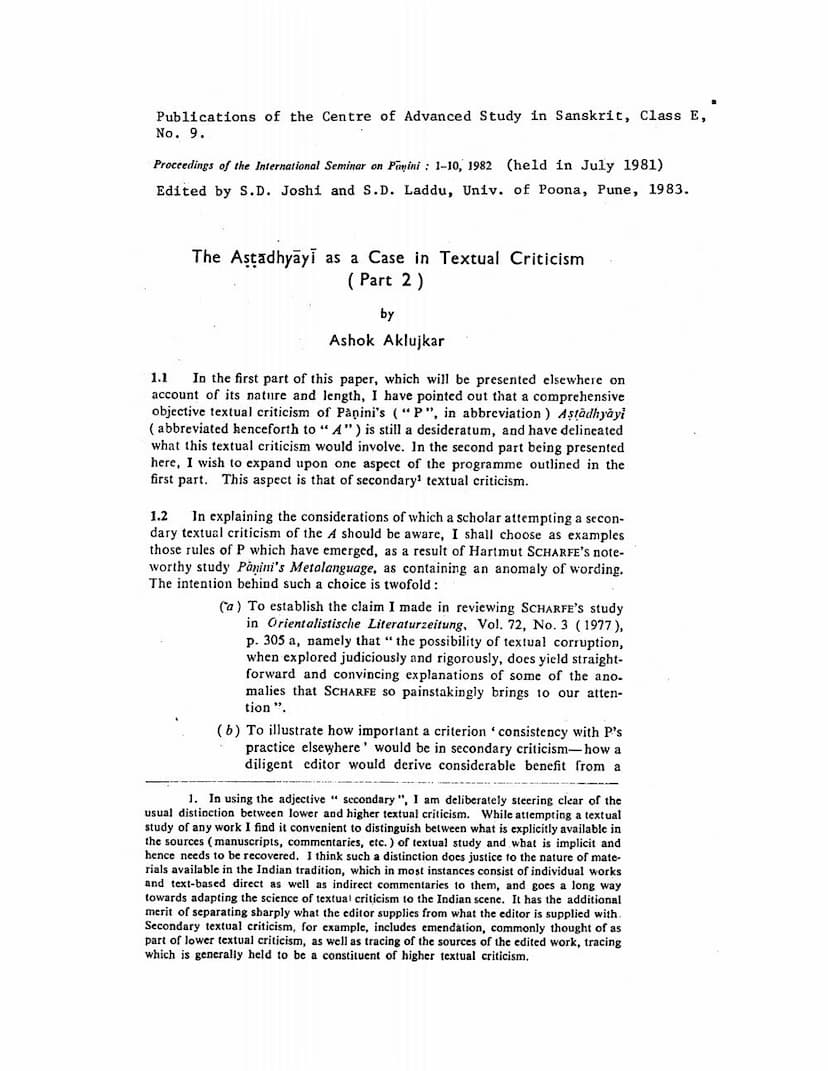
This paper, the second part of a larger discussion, focuses on the secondary textual criticism of Pāṇini's Aṣṭādhyāyī (A). The author, Ashok Aklujkar, argues that a comprehensive textual criticism of Pāṇini's work is still needed. Secondary textual criticism, in his view, involves going beyond what is explicitly available in manuscripts and commentaries to recover implicit information and suggest emendations. This approach is adapted to the Indian textual tradition, which often involves commentaries on original works.
Aklujkar aims to demonstrate that exploring the possibility of textual corruption can provide straightforward explanations for anomalies noted by scholars like Hartmut Scharfe in Pāṇini's Metalanguage. He also emphasizes the importance of consistency with Pāṇini's own practice elsewhere in the Aṣṭādhyāyī as a crucial criterion for textual criticism. To illustrate this, he analyzes several rules identified by Scharfe as having potentially problematic wording.
Key Examples and Arguments:
-
The Form śnasoh (6.4.111):
- The Anomaly: The rule concerns the root śna and the root as, and the expected form would be śnāsoḥ. However, the text reads śnasoh.
- Traditional Explanations: Commentators like Kaśikā and modern scholars like Böhlingk and Scharfe have offered explanations, often involving pronunciation aids or theories of auxiliary vowels. Mimamsaka suggests it's an abbreviation for as based on Apisali's views.
- Aklujkar's Argument: These explanations make Pāṇini seem whimsical and unpredictable, which is contrary to his usual practice. Aklujkar argues that the anomaly is likely due to textual corruption. He points out that Patañjali, in his Mahābhāṣya, discusses the rule multiple times without noting any peculiarity in śnasoh, suggesting Patañjali's version was the expected śnāsoḥ. The change to śnasoh likely occurred between Patañjali and the Kaśikā authors due to vowel shortening by scribes, a common phenomenon in manuscript transmission. The Candra Vyākaraṇa reading śnasol might further pinpoint the corruption period.
-
The Root Dṛś and its Variants:
- The Anomaly: Pāṇini uses different forms related to the root dṛś in various rules, specifically dṛśām, dṛśaḥ, and dṛśoh in one group of rules, and dṛsi in another. This suggests a potential inconsistency.
- Aklujkar's Argument: A stylistic analysis reveals that Pāṇini tends to use the stem ending in a consonant (dṛś) at the end of compounds and the stem ending in i (dṛsi) in non-final positions. The rule drśeḥ kvanip (3.2.94) is stylistically odd compared to rules like na dṛśaḥ (3.1.47) and tyad-ādiṣu dṛso 'nālocane kan ca (3.2.60). Aklujkar suggests that the original wording of 3.2.94 was likely dṛśaḥ kvanip, adhering to Pāṇini's practice of using consonant-ending forms when referring to a single root.
-
Usage of Suffix Markers (e.g., -e, -o, -ai, -au):
- The Anomaly: Pāṇini's practice is to refer to e and o by adding a time-marker 't' (e.g., et, ot), while ai and au are referred to without this marker. However, some rules deviate from this pattern.
- Aklujkar's Argument: He identifies rules like tita ātmane-padānam ter e (7.3.78), thasah se (7.4.16), samanodare śayita o codattah (4.4.108), and er līni (6.4.67) as potentially containing unexpected readings.
- ter e: He proposes the original reading might have been ter et, and the simplification to ter e could have occurred due to continuous recitation of rules.
- samanodare śayita o codattaḥ: He suggests oc codattah might have been simplified to oco 'dattah.
- er līni: He finds el līni (derived from et līni) probable, noting the common change of l to r and r to l in Sanskrit.
- dīva aut (7.1.84): Consistency suggests diva au, and the presence of t in neighboring rules (āt and it) might have led to the addition of t to au.
- aud ac ca gheḥ (7.3.118-119): Patañjali's modified formulation au dik ca gheḥ without the i after au suggests doubt about the original wording.
-
Sandhi Rules and Metalanguage:
- The Anomaly: Pāṇini often avoids sandhi in his metalanguage when it would obscure the grammatical element or operation being taught. However, some rules seem to violate this, or their transmission is unclear.
- Aklujkar's Argument:
- paḍ-dān-no-maślimi-nis-āsan-yilsan-dośan-yakai-chakann-udāsan chas-prabhṛti su (6.1.63) is suspect because it obscures the forms of adeśas (substitutions) and doesn't explicitly name the lexical items, contrary to Pāṇini's practice. The confusion in the bhāṣya tradition regarding whether Patañjali considered this a Pāṇinian rule adds to the doubt.
- namo hrasvad oci namun nityam (8.3.32) is argued to have been used inappropriately in metalanguage.
- The doubling of n in ūrnū (6.2.161) is likely due to the influence of the following anna, not Pāṇini's original intention.
-
Influence of Memorization and Related Rules:
- The Anomaly: The tradition of memorization in Sanskrit scholarship can lead to scribes being influenced by related rules, causing unintended changes in the text.
- Aklujkar's Argument:
- matau ca (4.4.136) is problematic because matau is used in the sense of matv-arthe (in the sense of matu suffix). Pāṇini typically uses compounds like matv-arthe to denote the meaning of a grammatical element, especially for verbal roots. The Kāśikā seems to have read matv-arthe here. Aklujkar suggests matau arose from scribal influence, possibly from the more appropriately used matau in 6.3.119, and then affecting other instances like 5.2.59.
- śaki lin ca (3.3.172) is also examined. While one could rationalize the use of śaki for śaky-arthe (meaning "is possible"), it goes against Pāṇini's usual procedure of adding artha and relies on contextual implication. Aklujkar suggests that the repeated use of śaki in an initial position in other rules might have influenced the wording śaky-arthe, making the memorization-based explanation more plausible than mere rationalization.
Conclusion:
Aklujkar concludes that careful use of word-indices of Pāṇini's work, combined with an understanding of the factors influencing textual transmission (like scribal errors and the impact of memorization), can significantly help in resolving textual puzzles in the Aṣṭādhyāyī. He stresses the importance of using traditional observations and solutions in a text-critical and historical manner, rather than resorting to idiosyncratic or merely "cosmetic" solutions that don't address the root cause of the anomaly. He implicitly calls for a rigorous approach to editing and understanding the Aṣṭādhyāyī.