
Asoka Et Les Gens De La Brousse
Added to library: September 1, 2025
Summary
Here's a comprehensive summary of the provided text, "Asoka et les gens de la brousse" by Colette Caillat, focusing on its content related to Jainism:
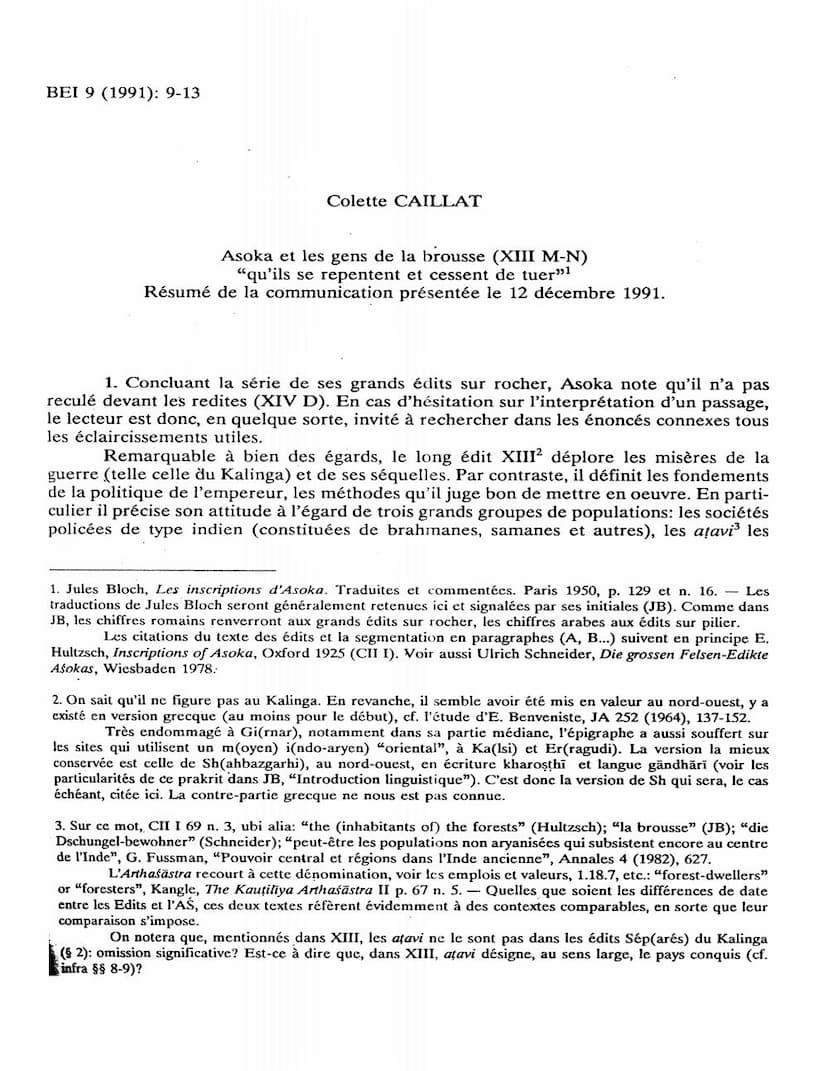
The article by Colette Caillat, "Asoka et les gens de la brousse" (Asoka and the Bush People), published in BEI 9 (1991), analyzes a key passage from Emperor Asoka's Great Rock Edict XIII (XIII M-N). The central theme is Asoka's policy towards a specific group of populations referred to as "atavi," often translated as "forest-dwellers" or "bush people."
Caillat begins by highlighting Asoka's consistent approach across his edicts, emphasizing the importance of repetition for clarity. She notes that Edict XIII, which laments the miseries of war (specifically the Kalinga war), is particularly significant as it outlines the foundations of Asoka's policy and his methods for interacting with different groups: civilized Indian societies (Brahmins, Sramanas, etc.), the "atavi," and foreigners beyond his borders.
A key point of discussion is Asoka's message to the "atavi" in Edict XIII (M-N). Asoka expresses his desire to win them over ("anuneti") and make them reflect ("anunijapeti"). He also explicitly mentions his own remorse ("anutape") and his strength. The passage then states a dual hope: that the "atavi" will repent ("avatrapeyu") and, critically, "na ca hamneyasu."
Caillat delves into the grammatical interpretation of "na ca hamneyasu," a phrase that has historically caused debate among scholars. While many have interpreted it as a passive construction, meaning "and that the atavi may not be killed," implying a veiled threat of punishment, Caillat argues against this. She posits that this interpretation leads to an incoherence in Asoka's otherwise benevolent message.
Instead, Caillat proposes an active voice interpretation based on linguistic analysis of the Middle Indo-Aryan verb root "hamn-." She argues that "na ca hamneyasu" (or "na hamnesu" in other variations) is likely an active optative, meaning "and that they may not kill." This aligns with Asoka's overall goal, as he concludes the passage by stating his wish for "security, restraint, and equanimity of soul in the face of violence" for all beings, and a desire for active participation in the "victory of the Law" (dhrama-vijaya).
The article connects Asoka's policies to broader Indian political thought, referencing the Arthaśāstra. Kautilya's treatise also discusses the "pacification of conquests" and the integration of conquered territories, including forest regions. Kautilya suggests that rulers should adopt the customs of the conquered but also defend the protection of animals, prohibit the killing of females and young, and prevent castration.
Caillat concludes that Edict XIII does not imply any retaliatory measures. Instead, Asoka aims to persuade the "atavi" to abandon practices that involve bloodshed and destruction of living beings and to encourage their participation in the "noble conquest of dharma" (the path of righteousness or law). This aligns with the general role of a sovereign in Indian legal texts, which is to establish the practice of dharma in newly conquered lands.
In essence, the article argues that Asoka's message to the "atavi" in Edict XIII is a call for repentance and a change in behavior, encouraging them to adopt non-violence and embrace the principles of the Law, rather than a threat of punishment. The active interpretation of "na ca hamneyasu" as "and they may not kill" is crucial for understanding the consistency and profundity of Asoka's humanitarian and ethical governance.