
Ardhamagadhi Ayadanda
Added to library: September 1, 2025
Summary
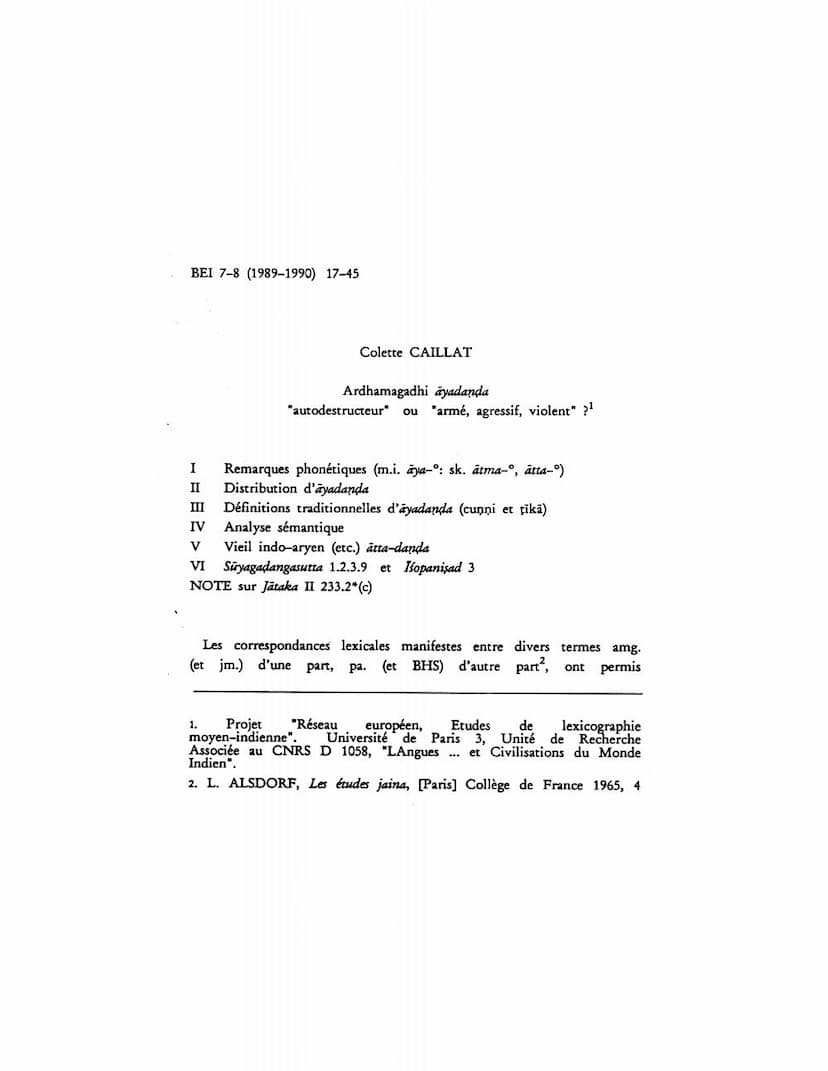
This article, "Ardhamagadhi ayadanda 'autodestructeur' ou 'armé, agressif, violent' ?!" by Colette Caillat, analyzes the Ardhamagadhi (Amg.) term ayadanda, primarily found in the Jain canonical text Suyagadangasutta (Süy).
The author addresses a debate regarding the meaning of ayadanda, which has been traditionally interpreted by Jain commentators as ātma-danda, suggesting "self-destructive" or "one who harms oneself." However, the article explores an alternative etymology proposed by W.B. Bollée, linking ayadanda to Pali atta-danda, derived from the verb a-DĀ (Sanskrit atta), meaning "armed" or "violent."
Key Points:
- Traditional vs. Alternative Interpretation: Jain commentaries often interpret ayadanda as ātma-danda, implying self-harm. Bollée suggests it derives from atta-danda, meaning "armed" or "violent."
- Linguistic Analysis: The article delves into the phonetic evolution of Indo-Aryan languages, explaining how ātman (Sanskrit) can evolve into aya- in Ardhamagadhi, while atta- (Pali), derived from a-DĀ, can also lead to aya- in certain Prakrit dialects. This linguistic ambiguity contributed to the interpretational difficulties.
- Contextual Evidence in Suyagadangasutta: Caillat meticulously examines the six occurrences of ayadanda in the Suyagadangasutta. She argues that the immediate context consistently associates ayadanda with terms denoting violence, aggression, and destruction (lūsa, himsā). This suggests that the primary meaning in the canonical text is "aggressive" or "violent" rather than "self-destructive."
- Comparison with Buddhist Traditions: The article notes similar interpretations in Buddhist literature (Pali, Buddhist Sanskrit, Gandhari Prakrit), where atta-danda is also understood as "violent" or "aggressive." It highlights that even in Buddhist commentaries, there were attempts to link atta- to ātman, suggesting a similar interpretational shift over time.
- Danda's Ambiguity: The term danda itself is shown to be ambiguous, meaning both "stick/weapon" (as an instrument of harm) and "retribution/punishment" (as suffering the consequences).
- Jain Doctrine and Interpretation: The author acknowledges that the Jain emphasis on self-inflicted suffering through karma might have influenced the commentaries to favor the ātma-danda interpretation, seeing the act of violence as ultimately harmful to the perpetrator's own soul (jiva). However, she argues this is more of an exegetical gloss or elaboration of a core tenet rather than the direct meaning of ayadanda in its original context.
- Archaic Nature: The term ayadanda is identified as an archaic word, mostly confined to the Süyagadangasutta.
- Conclusion: Caillat concludes that the original meaning of ayadanda in the Süyagadangasutta is "aggressive" or "violent," aligning with the Pali atta-danda. The interpretation of "self-destructive" is a later development, likely influenced by Jain philosophical concepts. The article argues against Jacobi's translation of "who work the perdition of their souls," favoring "wicked" or, more precisely, "aggressive" and "destructive."
In essence, the article provides a thorough linguistic and contextual analysis to argue that ayadanda in early Jain texts primarily signifies an active perpetrator of violence, rather than someone who harms themselves.