
Archiv Fur Indische Philosophie
Added to library: September 1, 2025
Summary
Here's a comprehensive summary of the provided text, focusing on its arguments and findings:
Core Argument: Challenging the Traditional View of the Mahābhāṣya and the Nature of Vārttikas
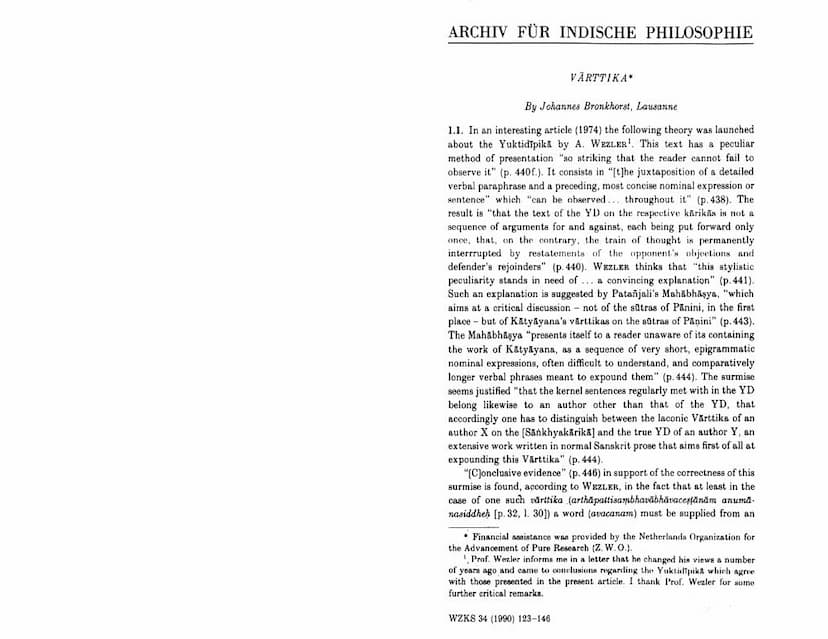
The article, "Vārttika" by Johannes Bronkhorst, critically examines the prevalent understanding of the structure and authorship of ancient Indian grammatical texts, particularly Patañjali's Mahābhāṣya and the nature of the "vārttikas" attributed to Kātyāyana. It proposes that the "striking method of presentation" in texts like the Yuktidīpikā (YD) and the Tattvārthavārttika, characterized by the juxtaposition of concise nominal statements (vārttikas) and their detailed verbal paraphrases, might reflect a more fundamental structural principle in earlier Sanskrit literature than previously assumed.
Wezler's Theory and Bronkhorst's Critique
Bronkhorst begins by discussing Albrecht Wezler's theory concerning the Yuktidīpikā (YD). Wezler argued that the YD's peculiar style – the interspersing of concise nominal expressions (vārttikas) with longer verbal explanations – suggests that the YD itself is a composite work. He proposed that the concise nominal expressions belonged to an earlier, distinct author (Author X), while the longer explanations formed the actual YD authored by someone else (Author Y), who aimed to expound the earlier vārttikas. Wezler cited evidence such as the use of anuṛtti (continuation of a word from a previous passage) between these nominal expressions and issues with the interpretation of the word hetumat in the YD as supporting his hypothesis. Wezler identified the earlier vārttikas as likely belonging to a text called the "Rājavārttika."
Bronkhorst acknowledges the possibility of Wezler's theory but expresses doubt about the conclusiveness of the evidence. He argues:
- Anuṛtti is not conclusive: The use of anuṛtti among the vārttikas is not unique and can be found within single-authored works (e.g., Candra's grammar and its commentary). One author could have adopted this style for clarity or mnemonic purposes, or by emulating the Mahābhāṣya.
- Hetumat interpretation is debatable: Bronkhorst analyzes the hetumat passage in detail and suggests that the objection raised by the opponent can be interpreted as a criticism of both the kārikā and the commentary's interpretation, rather than an illogical clash pointing to different authors.
The Crucial Evidence: The Tattvārthavārttika of Akalaṅka
Bronkhorst then presents what he considers "strong evidence against Wezler's theory" and in favor of his own line of argument: the Tattvārthavārttika of Akalaṅka. This Jain work, dating to the 7th or 8th century CE, is written in a style strikingly similar to the YD, alternating between short nominal sentences and detailed verbal explanations. Crucially, the Tattvārthavārttika is universally accepted as the work of a single author.
Bronkhorst uses examples from the Tattvārthavārttika to demonstrate that:
- Nominal sentences are not independent: The nominal sentences in the Tattvārthavārttika often cannot stand alone and require context from preceding commentary, indicating they are integral parts of the commentary, not separate prior works.
- Anuṛtti is integral: The use of anuṛtti between nominal sentences within the Tattvārthavārttika further supports the idea of a single author.
- The term "Vārttika" itself: Akalaṅka's work is explicitly titled Tattvārthavārttika. This suggests that "Vārttika" could refer to a literary composition that includes both short nominal statements and their extended explanations, rather than solely to the concise statements themselves.
Reinterpreting the Mahābhāṣya and the Role of "Vārttika"
Bronkhorst posits that the existence of works like the Tattvārthavārttika raises a significant question: could the Mahābhāṣya, along with Kātyāyana's vārttikas, have been perceived as a single, unified composition by one author at some point?
He argues that while later scholars and even Patañjali himself sometimes distinguish between the vārttikas and the bhāṣya, this distinction might not have been as clear or consistently maintained in earlier periods. He points to Kātyāyana's vārttikas as the prototype of the style seen in the YD and the Tattvārthavārttika.
Bronkhorst's analysis of Bharthari's Mahābhāṣyadīpikā (a commentary on the Mahābhāṣya) provides further support:
- Bharthari's use of "Vārttika": Bharthari uses the term "vārttika" not only to refer to Kātyāyana's explicit vārttikas but also to specific passages within the Mahābhāṣya itself, particularly those that are explanatory, or even those that are rejected but are integral to the argument. This suggests that for Bharthari, "vārttika" could encompass larger explanatory sections of the Mahābhāṣya, blurring the lines between what we consider vārttikas and what we consider bhāṣya.
- Distinction of Authors: Bharthari distinguishes between a vākya-kāra (author of vākya, referring to vārttikas) and a bhāṣya-kāra (author of bhāṣya). However, his classification of certain Mahābhāṣya passages as "vākya" suggests a broader definition of "vārttika" than just the short nominal statements. He also sometimes attributes passages to Kātyāyana that are present in the Mahābhāṣya, implying a perceived fusion of the two.
- The Vākyapadīya classification: Bharthari's Vākyapadīya itself outlines a fourfold division of grammatical literature: sūtra, anutantra (likely vārttikas), bhāṣya, and anutantra-bhāṣya. This indicates that the traditional strict separation of Patañjali and Kātyāyana was not necessarily Bharthari's view.
The Evolution of the Mahābhāṣya's Perception
Bronkhorst suggests that the names "Patanjali" and "Mahābhāṣya" might have emerged later to fill a perceived lacuna when the idea of a single author for the entire Mahābhāṣya (including the vārttikas) began to erode. He notes that early mentions of Patañjali are rare before Bharthari.
He also points to I-ching's account of Indian grammarians, who mentions a "Vrttisūtra" attributed to Jayaditya and a "Corni" attributed to Patañjala. Bronkhorst argues that this likely reflects an earlier perception of the Mahābhāṣya as a two-part work: a "Varttika" (which included more than just the nominal sentences) and the "Corni" (the remaining bhāṣya). This implies that the "Vrttisūtra" was not merely a commentary on the Kāśikā, as previously thought, but a designation for the vārttika-centric portion of the Mahābhāṣya.
Conclusion: A Broader Definition of "Vārttika"
In conclusion, Bronkhorst argues that the style exemplified by the Yuktidīpikā and the Tattvārthavārttika, characterized by the alternating short nominal statements and detailed verbal explanations, was likely a recognized literary category. The term "Vārttika" might have encompassed these entire composite works, and this broader definition could have influenced the perception of the Mahābhāṣya itself. The article challenges the sharp, modern distinction between Patañjali's authorship of the Mahābhāṣya and Kātyāyana's authorship of the vārttikas, suggesting a more fluid and integrated understanding in antiquity. The essay ultimately supports Wezler's identification of a distinct style of vārttikas but questions his conclusion that such style necessarily implies separate authorship for the Yuktidīpikā itself. Instead, it suggests that this style was adopted and integrated, and that the term "Vārttika" evolved to encompass these integrated works.