
Archiv Fur Indische Philosophie
Added to library: September 1, 2025
Summary
Here's a comprehensive summary of the provided Jain text, "Zum Verständnis des Bhasya zu Panini 3.3.18" by Albrecht Wezler, based on the content of the pages provided:
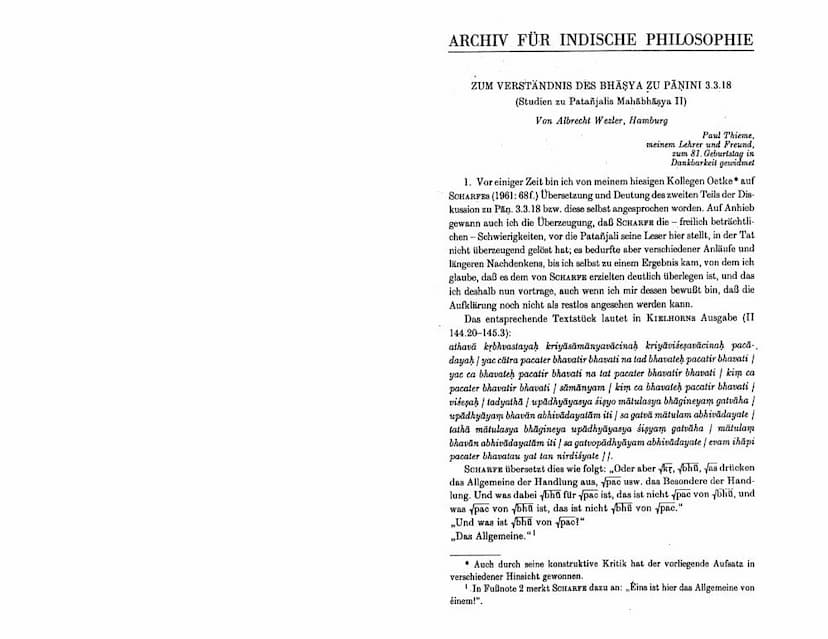
The article by Albrecht Wezler, titled "Zum Verständnis des Bhasya zu Panini 3.3.18" (To Understand the Bhasya on Panini 3.3.18), is a scholarly analysis dedicated to understanding a specific passage in Patanjali's Mahabhasya, a foundational text in Sanskrit grammar. Wezler focuses on the interpretation of the Mahabhasya's commentary on Panini's sutra 3.3.18, which deals with the term "bhāva" in relation to verbal nouns.
Wezler begins by expressing dissatisfaction with a previous interpretation by H. Scharfe (1961), particularly regarding Scharfe's understanding of Patanjali's example and his concept of "the general being the general of one" (das Allgemeine von einem). Wezler aims to provide a superior interpretation by delving deeper into the Mahabhasya text and its commentaries.
Key Issues and Wezler's Argument:
-
Scharfe's Interpretation and its Problems:
- Scharfe interpreted the passage (Mahabhasya II 144.20-145.3) as discussing the distinction between the general (sāmānya) and the particular (viśeṣa) in linguistic roots.
- Scharfe's central claim was that Patanjali suggests "one thing can be the general of another," which Wezler finds philosophically problematic and insufficiently explained by Scharfe.
- Scharfe used an example involving a student (A) and his teacher, and the student's maternal uncle's nephew (B). The example illustrates how the same person can be a teacher to one and an uncle to another, leading to different ways of addressing them. Scharfe interpreted this to mean the uncle is the "general" and the teacher is the "particular."
-
Wezler's Critique of Scharfe:
- Wezler argues that Scharfe's reliance on the idea of "the general being the general of one" is not adequately supported by the text, nor is it clearly explained.
- He points out that other passages Scharfe cites (e.g., Mahabhasya I 172.6-8) actually discuss the relativity of "general" and "particular" rather than the "general of one."
- Wezler also examines commentaries by Nāgojibhaṭṭa and Kaiyaṭa, who clarify that the term "bhāva" in Panini 3.3.18 signifies the general meaning that underlies specific verbal roots. They explain that while verbal nouns derived from different roots might have different genders and numbers, "bhāva" represents their common conceptual essence, like "cowness" for various terms related to cows.
-
Re-interpreting Patanjali's Example:
- Wezler argues that Patanjali's example is not primarily about the abstract philosophical distinction between general and particular in the sense Scharfe proposed.
- Instead, the example illustrates a more direct point: the way we speak is determined by the specific relationship we have to the person or thing being referred to. The choice of words like "teacher" or "uncle" depends on the speaker's perspective and relation.
- Crucially, Wezler emphasizes the final sentence of Patanjali's example (evam ihāpi pacater bhavatau yat tan nirdiśyate - "Thus, here too, what is indicated in bhū from pac..."). He argues that this sentence explicitly states what the example is meant to convey. It signifies that Panini, in sutra 3.3.18, uses "bhāva" to refer to what is indicated in the root bhū in relation to pac and similar roots. This "indicated" element is the "general" (sāmānya) that adheres to the "particular" (viśeṣa) expressed by roots like pac.
-
The Core Argument:
- Wezler proposes that the example serves to demonstrate the phenomenon of pragmatics or context-dependent expression. The speaker's choice of "teacher" or "uncle" is dictated by their immediate relationship, even though the person being addressed is the same.
- Therefore, the example is not about one concept being another in an abstract sense, but rather about how different expressions are used to denote the same entity based on the speaker's relational context.
- Patanjali's example implicitly highlights that Panini, in sutra 3.3.18, uses "bhāva" to denote the essence or meaning that the suffix conveys when attached to a verb root. This essence is what the suffix indicates in relation to the specific meaning of the root. The "general" (bhāva) is what inheres in the "particular" (the root's meaning).
-
Critique of Bandini:
- Wezler also addresses an interpretation by G. Bandini (1980), who attempts to elaborate on Scharfe's ideas. Wezler finds Bandini's explanation convoluted and argues that Bandini, like Scharfe, misunderstands the core function of Patanjali's example. Bandini's attempt to reconcile conflicting statements about verbal nouns is seen as missing the point of the Mahabhasya passage.
-
Methodological Considerations:
- Wezler emphasizes the importance of carefully analyzing the Mahabhasya text itself, particularly the concluding explanatory sentence of the example. He suggests that focusing on this sentence provides a more reliable path to understanding than relying on secondary interpretations or preceding sentences that might create misleading expectations.
- He also acknowledges that while the example uses persons and the grammatical discussion involves linguistic elements, the core principle of understanding relational context remains valid.
In essence, Wezler argues that Patanjali's example in the Mahabhasya on Panini 3.3.18 is not about a philosophical concept of "the general being the general of one" but rather about illustrating how the choice of linguistic expression is determined by the speaker's specific relational context. The example highlights that "bhāva," as taught by Panini, refers to the general semantic function of a suffix in relation to the particular meaning of a verb root. The article provides a detailed linguistic and philosophical analysis, engaging with previous scholarship and offering a refined interpretation of a complex grammatical discussion.