
Apoha Theory Of Dignaga
Added to library: September 1, 2025
Summary
Here's a comprehensive summary of the provided text on Dignāga's Apoha Theory by Shoryu Katsura:
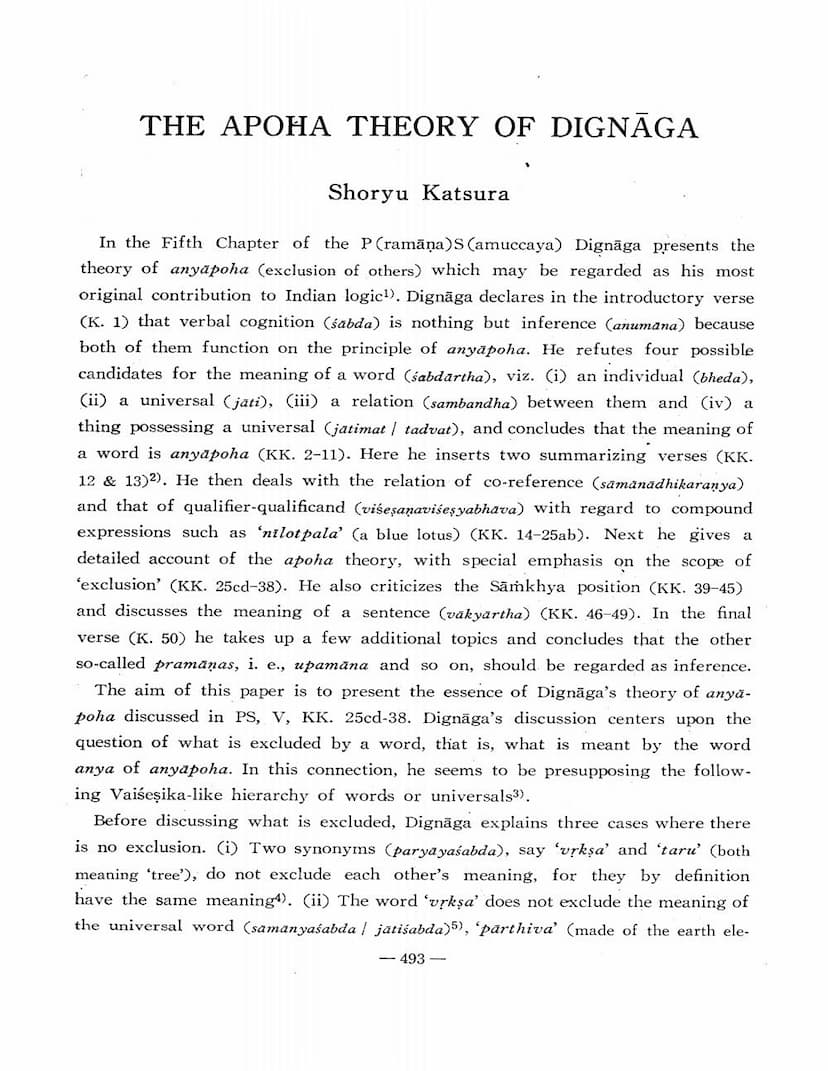
The text, "Apoha Theory of Dignāga" by Shoryu Katsura, focuses on Dignāga's highly original contribution to Indian logic: the theory of anyāpoha (exclusion of others). Dignāga, in the fifth chapter of his Pramāṇasamuccaya (PS, V), asserts that verbal cognition (śabda) is fundamentally inferential (anumāna) because both operate on the principle of anyāpoha.
Core of the Apoha Theory:
Dignāga argues that the meaning of a word is not an individual entity, a universal, a relation, or a thing possessing a universal. Instead, the meaning of a word is understood through exclusion. A word signifies something by excluding everything else.
Exclusion and Non-Exclusion:
Dignāga outlines specific scenarios of exclusion and non-exclusion between words, particularly universal words. He establishes rules governing these relationships:
-
No Exclusion (Non- Exclusion):
- Synonyms: Words with the same meaning (e.g., 'urksa' and 'taru' for 'tree') do not exclude each other's meaning.
- Lower Order Encompassing Higher Order: A word of a lower universal order does not exclude, but rather encompasses, the meaning of a higher universal order with which it has an invariable relation (i.e., if the lower is absent, the higher is also absent). For example, 'tree' (vrkşa) encompasses 'earth-element' (pārthiva), 'substance' (dravya), and 'existent' (sat).
- Higher Order Awaiting Determination of Lower Order: A word of a higher universal order neither excludes nor encompasses the meanings of lower universal orders. Instead, it creates expectation or doubt about which specific instance it refers to. For instance, 'existent' (sat) doesn't exclude 'substance' (dravya) or 'tree' (vrkşa) but raises the question of whether the existent is a substance, quality, or action.
-
Exclusion: Dignāga identifies two types of apoha:
- Direct Exclusion: Two universal words of the same order directly exclude each other's meaning. For example, 'tree' (vrkşa) excludes 'pot' (ghaṭa) because they share a common universal ('being made of the earth element' - pārthivatva) but are incompatible within that universal. Once something is a tree, it cannot be a pot.
- Indirect Exclusion: A word of a lower universal order indirectly excludes whatever is directly excluded by words of higher order with which it has an invariable relation. For instance, 'tree' (vrkşa) indirectly excludes 'water-element' (āpya) because 'tree' encompasses 'earth-element' (pārthiva), and 'earth-element' directly excludes 'water-element'.
-
Disregard: A related concept is "disregard." A word of a lower universal order "disregards" that which is directly excluded by higher order words with which it has an invariable relation. For example, 'earth-element' (pārthiva) indirectly excludes 'quality' (guna), and 'quality' neither excludes nor encompasses 'color' (rūpa). Thus, 'earth-element' disregards 'color'.
Key Aspects and Nuances:
The paper highlights several other significant points within Dignāga's discussion:
- Meaning of 'Samanadhikaranya': This term can mean "referring to the same thing" or "having the same locus." Dignāga uses both meanings, but primarily the former.
- Anvaya and Vyatireka: Dignāga, like Indian grammarians, uses anvaya (employment in similar cases/when a meaning is intended) and vyatireka (non-employment in dissimilar cases/when a meaning is not intended) as means for a word to express its meaning. Dignāga's formulation is from the speaker's perspective, while grammarians' are from the listener's.
- Rejection of 'Pravṛttinimitta': Dignāga rejects the idea that a universal (like 'colorness' for the word 'color') is the direct ground for applying a word. Instead, he argues that word usage is based on linguistic convention accepted by ordinary people.
In essence, Dignāga's apoha theory posits that meaning is constructed through a process of negation and exclusion. A word identifies its referent by demarcating it from all other entities, thereby enabling definite conceptual understanding. This theory is presented as the foundation for understanding verbal cognition and its inferential nature.