
Anmerkunjen Zu Einer Buddhistichen Texttradition Parlokasiddhi
Added to library: September 1, 2025
Summary
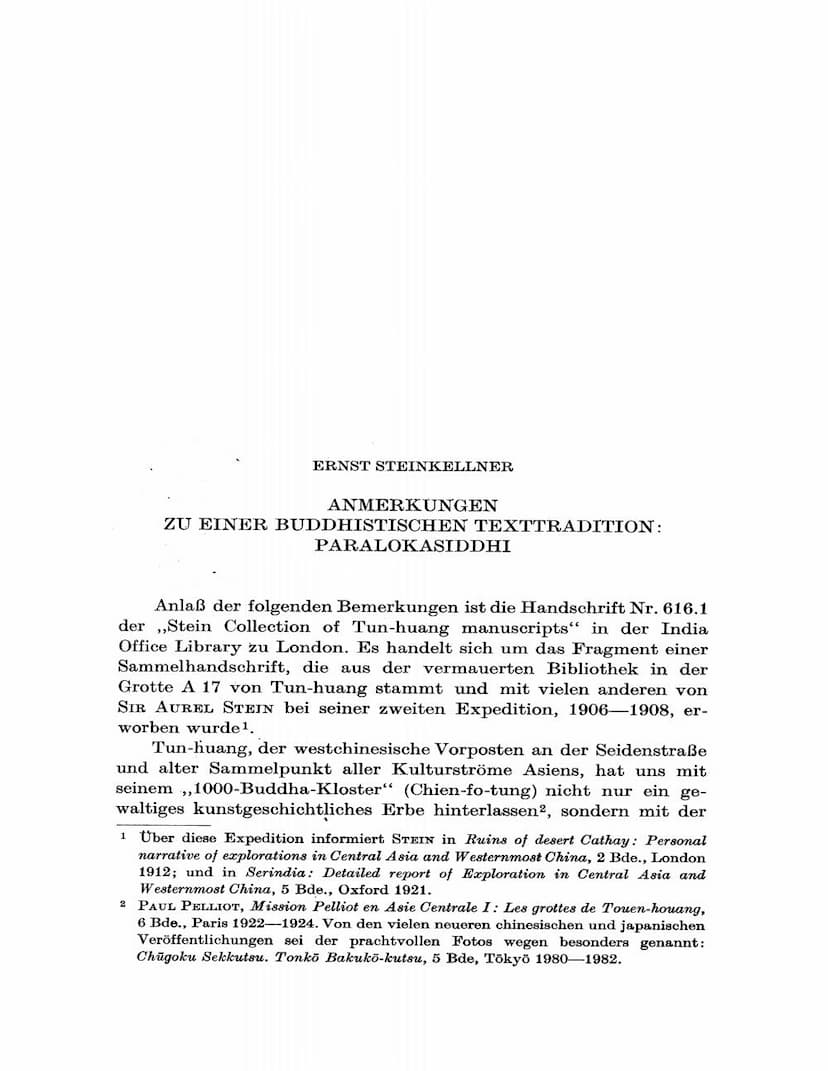
Here is a comprehensive summary of Ernst Steinkellner's "Anmerkunjen Zu Einer Buddhistichen Texttradition Paralokasiddhi":
Introduction and Discovery:
The article by Ernst Steinkellner introduces a significant Buddhist text fragment titled 'Jig-rten pha-rol sgrub/bsgrub-pha, which translates to Paralokasiddhi in Sanskrit, meaning "Proof of the Other World." This fragment was discovered among the Tun-huang manuscripts, specifically in the Stein Collection at the India Office Library in London. The Tun-huang region, a crucial cultural crossroads in Central Asia, yielded a vast collection of manuscripts, including a substantial number of Tibetan texts. These Tibetan manuscripts are particularly valuable as they represent an older form of the language, predating the orthographic and terminological reforms of the early 9th century, making them a vital source for understanding early Tibetan literature and linguistics. Steinkellner notes that while the initial discovery of Tun-huang manuscripts was characterized by a "treasure-seeking" approach, new "treasures," especially in the realm of religious-philosophical literature, continue to emerge.
The Text and its Author:
The discovered text, identified as Paralokasiddhi by Prajñāsena, is described as a short work, consisting of seven folios written in an old Tibetan cursive script. It includes interlinear glosses, which become sparser as the text progresses. The author, Prajñāsena, was previously unknown. The text's significance lies in its unique approach to presenting Buddhist teachings in a concise manner, aimed at educating and convincing the audience. This didactic character makes it particularly interesting.
Contextualizing Paralokasiddhi:
Steinkellner distinguishes the newly found Paralokasiddhi from a previously known text of the same name by Dharmottara (around 800 AD). Dharmottara's work, preserved in an 11th-century Tibetan translation, is a complex essay on the continuity of consciousness and rebirth, classified under "epistemology" in the Tibetan canon. It is considered a typical early example of Buddhist "proof treatises" from the epistemological-logical school that emerged in the 8th century.
In contrast, Steinkellner's Paralokasiddhi belongs to a different tradition. While it resonates with the epistemological-logical school, it predates its origins in terms of methodology and content. It is identified as a Mahāyāna treatise whose methodology aligns with categories found in the 10th chapter of the Samdhinirmocana Sūtra.
Chronology and Authorship of Paralokasiddhi Texts:
Steinkellner explores the existence of multiple Paralokasiddhi texts around the 8th/9th centuries:
- Dharmottara's Paralokasiddhi: Preserved in the Tibetan canon (P 5749), belonging to the epistemological-logical school.
- An unpreserved text with the same title, mentioned in an 812 or 824 catalog of the royal palace library of Han-dkar.
- 'Jig-rten pha-rol bsgrubs-pa by mKhan-po Ye-ses-sde: Listed under "Mahāyāna Treatises" in the Han-dkar catalog. This is important as it is a Tibetan original work, not a translation from Sanskrit. Ye-ses-sde (Sanskrit: Jñānasena) was a prominent figure in the Central Tibetan translation school of the late 7th and early 8th centuries.
- The Paralokasiddhi by Prajñāsena (the text under discussion) from the London collection. Steinkellner argues against its identification with Ye-ses-sde's work due to differences in length and the distinctness of the Sanskrit terms jñāna and prajñā (Tibetan: ye-ses and ses-rab).
- A Paralokasiddhi by Subhagupta (c. 720–780): Mentioned in a gloss to the text, it is considered a model for Prajñāsena's work. It might also be the text titled Pha-rol-gyi yul grub-pa in the Han-dkar catalog.
Therefore, besides Prajñāsena's text, there are three other Indian texts with the same title translated into Tibetan, and one original Tibetan work. Most of these were composed between the mid-8th and early 9th centuries. Prajñāsena's Paralokasiddhi is generally dated between the late 8th and early 11th centuries (before the library was sealed around 1035).
Translation vs. Original Tibetan Work:
Steinkellner addresses whether the text is a translation from Sanskrit or an original Tibetan composition. He notes that linguistic criteria are difficult to apply due to the existence of "Chos-skad" (religious language) used by Tibetan scholars for both translated and original religious works. He relies on textual criteria, both formal and content-related.
Evidence for Tibetan Authorship of the Glosses:
The glosses are clearly a Tibetan creation. Steinkellner provides an example of the explanation for the term mu-stegs-can (Sanskrit: tirthika). The gloss offers a Tibetan etymology based on a superficial resemblance of sounds (stegs to rtag and can to chad), linking it to the Buddhist concept of "extremes" (eternalism and annihilationism). This kind of schema-based, potentially forced, explanation reflects a Tibetan intellectual approach rather than a direct translation of an Indian etymology.
Evidence for Tibetan Authorship of the Main Text:
Formal elements suggest the main text is also an original Tibetan work:
- Lack of a standard introduction: Indian texts typically begin with an introduction outlining the subject, occasion, and benefit. This is absent here, suggesting the work might have started directly by refuting an opponent's view.
- Unusual opening: The text begins with an introduction to generally accepted doctrines (siddhānta) rather than immediately presenting a counter-argument (parvapaksa), which is uncommon for Indian practice.
- Disordered presentation of opposing views: The system for presenting opposing positions is less ordered than would be expected from scholarly Indian tradition of that period.
The Tradition of Proving the Other World:
Steinkellner then delves into the intellectual tradition of developing arguments for the existence of an "other world" (rebirth). He outlines the historical development of these arguments:
- Pre-Buddhist Indian thought: The concept of an endless cycle of birth and death was inherited from the late Vedic period. The idea that one's actions (karman) determine one's existence in this cycle was also prevalent. The term loka (world) evolved to denote various spheres of existence, with para-loka (other world) referring to previous or future existences.
- Early Buddhist schools (Hinayāna): Early Buddhism accepted the cycle of rebirth but questioned what transmigrates. The Buddhist position is that no eternal soul (ātman) transmigrates, but rather a stream of consciousness (cittasantāna), which is a causally linked series of momentary mental and physical constituents (skandhas).
- Materialism: Skeptical and materialistic schools denied the existence of an other world and an eternal soul, viewing mind as a product of material elements. These materialistic arguments were often used in political theory and were developed to refute rebirth.
- Buddhist Apologetics: Initially, Buddhists responded with practical measures, like using parables or miracles to dissuunt rulers from cruel practices by suggesting retribution. Later, they developed arguments to demonstrate that actions have consequences and that rebirth is necessary for retribution.
- Mahāyāna Buddhism: The Mahāyāna, with its emphasis on compassion (karuṇā) and universal knowledge (sarvajñatā), further motivated the need for proving rebirth. The ideal of the Bodhisattva, who postpones their own liberation to help all beings, requires countless lifetimes for the development of these qualities. This reinforced the idea of an infinite series of births, becoming a prerequisite for religious practice.
- The Samdhinirmocana Sūtra: This Mahāyāna sūtra (2nd/3rd century CE) already incorporated arguments for the other world within its methodology.
- The Epistemological-Logical School: This school (emerging in the 6th century CE) made the rigorous proof of rebirth a fundamental element of its philosophy, aiming to provide a philosophical grounding for Buddhism.
Steinkellner highlights that the methodology of the Samdhinirmocana Sūtra, particularly its logical and argumentative structure, remained influential. This methodology, termed the "methodology of the Samdhinirmocana Sūtra," includes categories of reasoning (nyāya) and investigation (parīkṣā). The upapattisiddhinyāya (argumentation proving through arguments) from this sūtra, which utilizes means of knowledge like perception, inference, and testimony, is seen as a self-sufficient method of proof.
Prajñāsena's Paralokasiddhi in Context:
Prajñāsena's Paralokasiddhi is presented as the last surviving work of this tradition, demonstrating its continued vitality around 800 AD. It does not merely repeat old arguments but incorporates insights from discussions relevant to the 7th/8th centuries, including the work of the epistemological school, but within the methodological framework of the Samdhinirmocana tradition. Subhagupta's work, serving as a model, and Ye-ses-sde's Tibetan original are also placed within this tradition.
Significance for Tibetan Buddhism:
The fact that a Tibetan scholar, Ye-ses-sde, authored an original treatise on this topic is notable, given the limited number of surviving Tibetan original works from that period. This suggests that the proof of rebirth was of particular interest to the early Tibetan adopters of Buddhist scripture and culture.
Steinkellner hypothesizes that this interest might stem from the need to introduce and establish fundamental Buddhist concepts like karma and rebirth in Tibet. While pre-Buddhist Tibet likely had the idea of a soul distinct from the body, it lacked the concepts of an eternal cycle of life and death, a regulating principle for this cycle, or a cycle of existences without a soul. The effective propagation of Buddhist morality in Tibet would have been impossible without the acceptance of these core ideas.
Therefore, Prajñāsena's Paralokasiddhi is not just a late, simple treatise but a significant attempt by a Tibetan specialist to elucidate this crucial complex of ideas within the framework of Indian Buddhist doctrine, tailored for the new cultural environment. The study of such texts, with their imperfections, provides valuable insight into the comprehension difficulties and interpretational challenges faced when integrating sophisticated Indian Buddhist thought into Tibetan culture in the 8th and 9th centuries.