
Alt Und Neu Undische Studien
Added to library: September 1, 2025
Summary
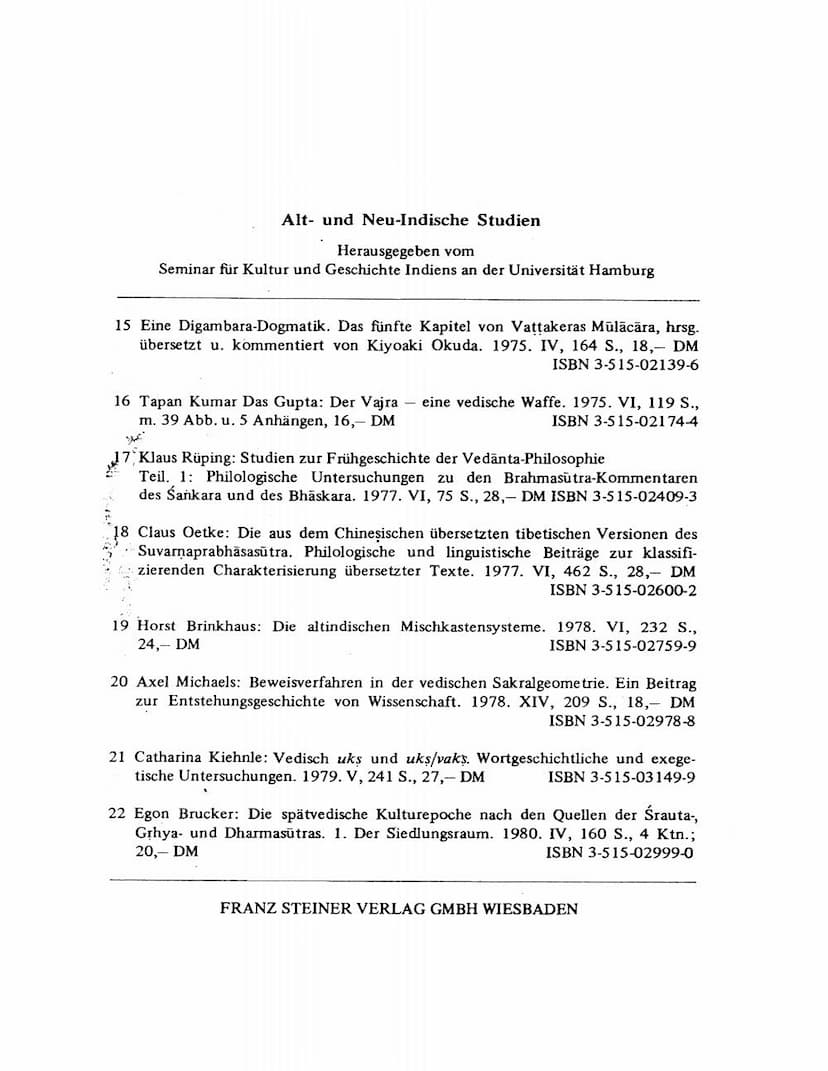
This document appears to be a page from a scholarly publication detailing various studies in Indian history and philosophy, specifically focusing on Buddhism. The table of contents on page 1 lists several titles related to Indian studies, including one specifically on Jainism: "Eine Digambara-Dogmatik. Das fünfte Kapitel von Vattakeras Mūlācāra, hrsg. übersetzt u. kommentiert von Kiyoaki Okuda." (A Digambara Dogmatics. The fifth chapter of Vattakera's Mūlācāra, edited, translated, and commented on by Kiyoaki Okuda). This indicates that the publication series covers a broad spectrum of Indian religious and philosophical traditions.
The subsequent pages (pages 2-11) present an academic article titled "Liberating Insight" and "Enlightenment" in Early Buddhism by L. Schmithausen. This article delves into the complex doctrinal nuances of what constitutes "Liberating Insight" and "Enlightenment" within different schools of early Buddhism, primarily the Sarvāstivāda and Theravāda.
Here's a breakdown of the key themes and arguments presented in the article:
Central Focus: The article investigates the differing interpretations of "Liberating Insight" (often translated as vijñāna or prajñā) and its relationship to "Enlightenment" across various Buddhist traditions. It highlights the challenges in reconciling canonical descriptions with later scholastic elaborations.
Sarvāstivāda Perspective:
- Multiple Attainment Levels: Sarvāstivādins believed "Liberating Insight" could be attained in various meditative states (dhyānas) and even in the intermediate state between the first and second dhyāna.
- Buddha's Enlightenment: The article notes that texts focusing on the Fourth Dhyāna for acquiring "Liberating Insight" might be referring specifically to the Buddha's enlightenment, which occurred in the Fourth Dhyāna.
- Nirvana as the Goal: Nirvana is seen as the content of "Liberating Insight," understood as the comprehension of the Truth of Cessation.
- No Mystical Ecstasy: Unlike some other theories, Sarvāstivāda does not posit a final liberation through mystical ecstasy into a supramundane sphere. The attainment of samjñāvedayitanirodha (cessation of perception and feeling) is considered similar to Nirvana but not Nirvana itself, and it's attained in a state devoid of consciousness.
- Intramundane Path: The "Mundane Path of Practice" is an intramundane process that cannot go beyond the Sphere of Neither-Consciousness-nor-Non-consciousness.
Theravāda Perspective:
- Suttas as Primary Sources: The Theravāda interpretation draws from Suttas like AN 10.6 and the Mahāmālunkyasutta.
- Preparatory Phase: The Mahāmālunkyasutta is interpreted to include both "Liberating Insight" proper and a crucial preparatory phase. This phase involves entering dhyānas and the first three States Beyond Visible Matter, along with insight into the impermanence, disagreeableness, and non-self nature of dharmas. This insight is often seen as a result of analytical observation after re-emerging from concentration.
- Nirvana as the Sole Object: "Liberating Insight" proper is understood to have Nirvana as its sole object, specifically the comprehension of Nirvana as peaceful and excellent.
- Less Intellectual Nirvana: Later Theravādins' Nirvana experience is described as less intellectual, but still not a mystico-existential anticipation. It's characterized as mystical cognition (ñāṇa) or intuition (nāṇadassana) occurring within the dhyānas.
- Visuddhimagga and Patisambhidāmagga: These texts present further complexities. While they affirm Nirvana as the sole object of "Liberating Insight," they also describe this insight as fulfilling a fourfold function, encompassing all Four Noble Truths. The term "attainment" (abhisamaya) is interpreted differently for each truth: "knowing completely" for Suffering, "elimination" for Origination, "realization" for Cessation (Nirvana), and "practicing" for the Path.
- Harmonizing Doctrines: The article suggests the Visuddhimagga attempts to harmonize the doctrine of "Liberating Insight" as comprehension of the Four Noble Truths with views that it focuses on only one truth (Suffering or Cessation/Nirvana).
- "Asamoha" (Non-delusion): The Paramatthamanjūsā uses the term asamoha (non-delusion) to describe how the other truths are "understood" in the moment of "Liberating Insight," suggesting an implicit or virtual kind of knowledge.
Harivarman's Tattva- (or Satya-)siddhi:
- Rejection of Vaibhāsikas: Harivarman rejects the Vaibhāsika view that liberation comes from fully comprehending the Four Noble Truths, arguing they primarily refer to Conventional Truth.
- Key Role of Suffering Comprehension: He emphasizes the importance of comprehending Suffering, particularly the emptiness (śūnya) and essencelessness (anātman) of the skandhas.
- Essencelessness and Cessation: Insight into essencelessness is seen as immediately provoking insight into the Truth of Cessation.
- Cessation as Ultimate Truth: Strictly speaking, defilements are eliminated only by insight into the Truth of Cessation, which is the Ultimate Truth. This insight involves no perception of mundane factors, only Cessation, which is unconditioned.
- "Intellectualist" Conception: Harivarman's position is described as more "intellectualist" as he believes "Liberating Insight" can occur even at the ordinary mental level (kāmadhātu), not necessarily requiring deep meditative states.
- Link to Canonical Texts and Pali School: His view is seen as closely related to canonical texts and the Pali interpretation of the Mahāmālunkyasutta, with a key difference being his more intellectual conception of Cessation and insight into it, and his interpretation of anātman as dharmanairātmya, creating a link between understanding the negative nature of existence and insight into Cessation.
Mahāyāna Buddhism:
- Fusion of Traditions: Mahāyāna generally does not maintain the distinction between comprehending essencelessness and comprehending Cessation, fusing the "positive" and "negative" traditions.
- Mystical Experience: Mahāyāna descriptions of "Liberating Insight" often refer to a mystical experience, similar to samjñāvedayitanirodha in its anticipatory realization of Nirvana, but clearly distinguished from it as it involves consciousness (albeit transconceptual).
Overall Significance: The article provides a detailed comparative analysis of key Buddhist concepts, highlighting the diversity of interpretations within early Buddhism regarding the path to liberation. It demonstrates how philosophical schools developed and adapted doctrines to reconcile different canonical sources and address complex soteriological questions. The inclusion of a Jain text in the broader series suggests a comparative approach to Indian religious thought, even though this specific article focuses solely on Buddhism.