
Ajaya Ajeya And Ajayya
Added to library: September 1, 2025
Summary
Here is a comprehensive summary of the provided Jain text, "Ajaya Ajeya and Ajayya" by M.A. Mahendale:
The article by M.A. Mahendale examines the nuanced meanings of three Sanskrit words: ajaya, ajeya, and ajayya, all of which generally translate to "invincible," "unconquerable," or "unsurpassable." However, the author argues for a deeper understanding based on grammatical tradition and historical usage, particularly within the context of Pāṇini's grammatical rules.
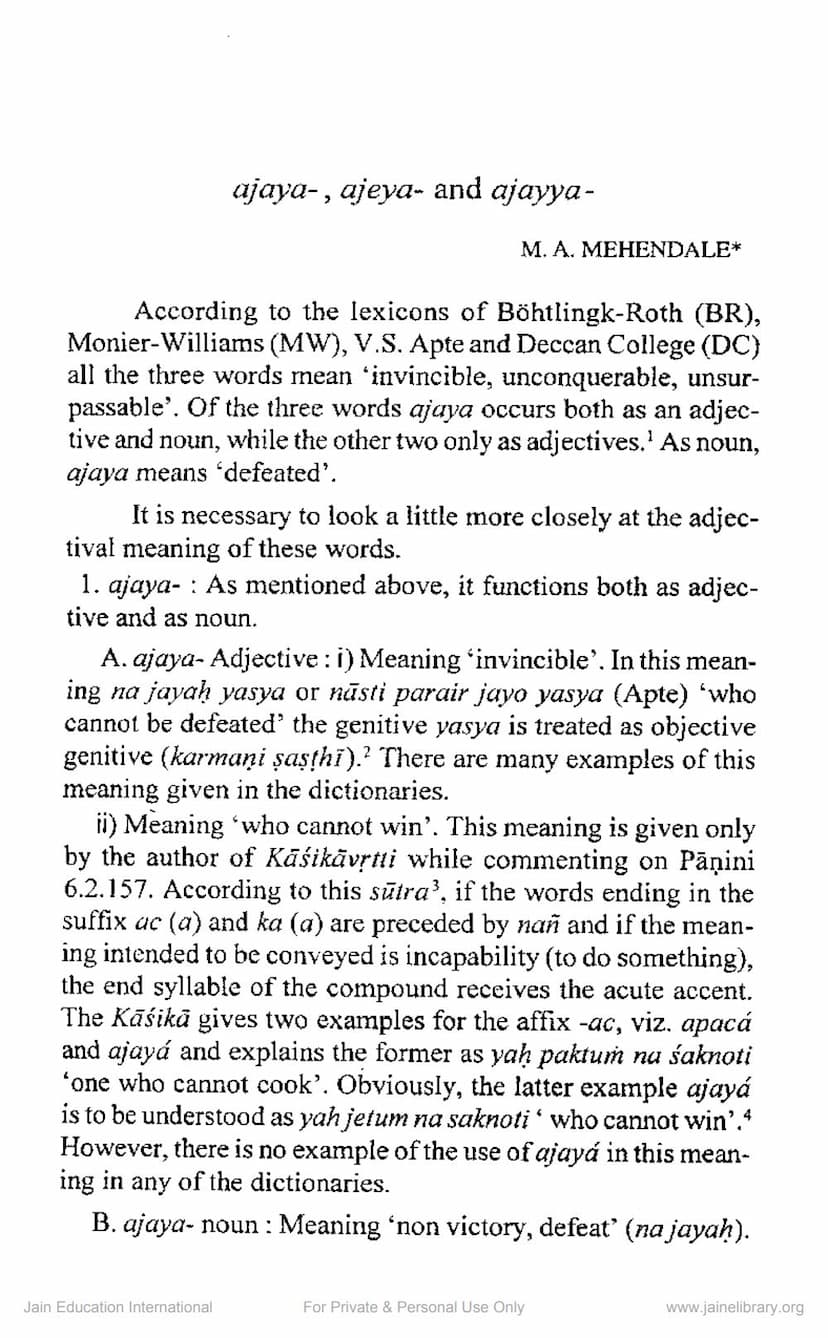
1. ajaya-
- Dual Functionality: ajaya can function as both an adjective and a noun.
- Adjectival Meanings:
- 'Invincible' / 'Unconquerable': This is the most common meaning, understood as "one who cannot be defeated" (na jayaḥ yasya or naști paraiḥ jayo yasya). The genitive case here is interpreted as an objective genitive. Dictionaries widely support this meaning with numerous examples.
- 'Who cannot win': This meaning is attributed to the Kāśikā commentary on Pāṇini 6.2.157. This interpretation arises when the word is formed with the suffix '-ac' and the prefix 'nañ' (negation), signifying incapability. The example given is apacā (one who cannot cook), implying ajaya would mean "one who cannot win." However, the author notes a lack of dictionary examples for ajaya in this specific sense.
- Noun Meaning: As a noun, ajaya means "non-victory" or "defeat" (na jayah). Dictionaries provide many examples for this usage.
2. ajeya-
- Common Dictionary Meaning: Dictionaries like Böhtlingk-Roth (BR), Monier-Williams (MW), and Deccan College (DC) primarily define ajeya as "invincible" or "unconquerable," citing many examples.
- Pāṇinean Tradition Interpretation: According to Pāṇini's grammatical tradition, the meaning of ajeya should be "one who does not deserve to be conquered" or "whom it is improper to conquer." This is derived from jeya, which means "one who deserves to be conquered" or "whom it is proper to conquer."
- Contradiction and Convention: The author highlights a discrepancy: while Pāṇini's tradition suggests a meaning of impropriety of conquest, dictionary citations (especially from DC) lean towards "invincible." This latter meaning is considered to have been adopted through convention (rūdhi) rather than strict grammatical basis.
- Support for Traditional Meaning:
- V.S. Apte and Śabdakalpadruma assign ajeya the meaning "not fit to be conquered," aligning with the grammatical tradition, though Apte provides no examples.
- The author points to a passage from the Jaiminiya Brāhmaṇa 1.265 as a strong example supporting the Pāṇinean interpretation. The passage discusses Brāhmaṇas who, when they sang certain samans correctly, were held in respect and deemed ajeyāḥ (not deserving of defeat). Conversely, when they sang improperly, they lost their respected position and suffered defeat. This context strongly suggests ajeya means "not deserving of being conquered" rather than "unconquerable."
- Historical Development: The author suggests that the meaning of "invincible" for ajeya likely emerged after Pāṇini's time, with its earliest documented use in the epic period.
3. ajayya
- Grammatical Basis: Based on Pāṇini's rule 6.1.81 (kṣayyajayyau sakyārthe), jayya means "one who can be conquered" or "whom it is possible to conquer." Therefore, ajya unambiguously means "whom it is not possible to conquer" or "invincible."
- Dictionary Support: Dictionaries provide numerous examples supporting this clear meaning of "invincible."
- Exception (Footnote 6): While generally unambiguous, the Śabdakalpadruma provides an additional meaning for ajya as "that which it is improper to win (in play)," citing Vopadeva. However, the author finds this meaning unsuitable for the cited context and suspects a possible error.
Conclusion:
The article concludes by summarizing the findings:
- ajya is the only word that unambiguously means "invincible" based on grammatical tradition.
- ajaya can mean "invincible," but it is ambiguous as it can also mean "one who cannot win."
- ajeya has come to be widely used to mean "invincible" since the epic period, but this usage lacks a strong basis in grammatical tradition. Grammatically, it should mean "whom it is not proper to conquer."
The author's analysis emphasizes the importance of considering grammatical rules and historical context to understand the precise meanings of these related Sanskrit terms, highlighting that common usage may sometimes diverge from strict etymological and grammatical interpretations.