
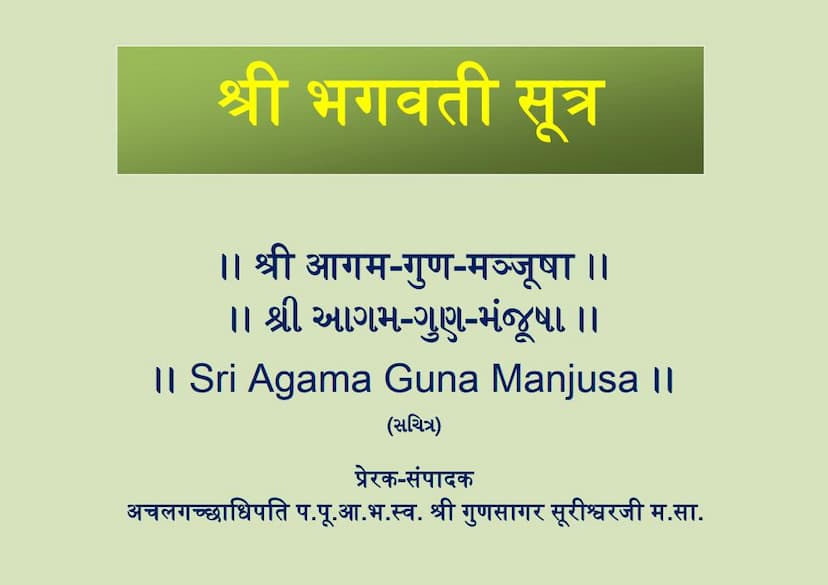
Agam 05 Ang 05 Bhagvati Vyakhya Prajnapti Sutra Shwetambar Agam Guna Manjusha
Added to library: September 1, 2025
Summary
Based on the provided text snippets, the Jain text "Agam 05 Ang 05 Bhagvati Vyakhya Prajnapti Sutra Shwetambar Agam Guna Manjusha" by Gunsagarsuri, published by Jina Goyam Guna Sarvoday Trust Mumbai, appears to be a comprehensive commentary or guide to the Jain Agamas, specifically focusing on the Bhagvati Sutra (also known as Vyakhya Prajnapti).
Here's a breakdown of what the text covers, based on the provided pages:
Overall Nature of the Text:
- Commentary on Agamas: The title "Agam 05 Ang 05 Bhagvati Vyakhya Prajnapti Sutra Shwetambar Agam Guna Manjusha" clearly indicates it's a commentary (Vyakhya) on the Bhagvati Sutra, which is the fifth Anga (limb) of the Shwetambar Jain canon. The title "Agama Guna Manjusha" (Treasure of Agama Virtues) suggests it aims to explain the virtues and teachings within the Agamas.
- Comprehensive Outline: The text provides a brief introduction to all 45 Agamas, detailing the classification: 11 Angas, 12 Upangas, 10 Payannas, 6 Cheda Sutras, and 4 Mula Sutras, along with two Chulikas.
- Focus on Bhagvati Sutra: While it introduces all Agamas, the core of the text, as evidenced by the detailed breakdown in Gujarati and English, is the Bhagavati Sutra. The text highlights its immense size (over 15,000 ślokas) and its nature as a question-and-answer compilation between Lord Mahavira and Gautama Ganadhara, covering all four Anuyogas (teachings on entity, calculation, religious discourse, and conduct).
- Detailed Chapter Summaries: The bulk of the provided text consists of detailed summaries of the various chapters (shatakas) and sections (uddeshakas) within the Bhagvati Sutra. These summaries cover a vast range of topics, from cosmology, metaphysics, and karma theory to the conduct of monks and nuns, and even specific life stories.
Key Agamas and Their Content (as per the outline):
-
11 Angas:
- Acharya Sutra: Describes the conduct of monks and householders.
- Sutrakritanga Sutra: Discusses doctrine-holders, ritualists, non-ritualists, etc., with a focus on the "teaching of entity."
- Sthananga Sutra: Primarily deals with calculation and introduces topics from single objects to eight objects.
- Samavayanga Sutra: An compendium listing objects from 1 to 100, then 150, 200 to crores.
- Vyakhya Prajnapti Sutra (Bhagavati Sutra): The largest, covering the four teachings, with 42 centuries and 1925 topics, detailing questions by Gautama Ganadhara and answers by Lord Mahavira. It's called a "treasure of gems."
- Jyatadharmakathanga Sutra: Focuses on religious discourses, containing numerous stories.
- Upasakadasanga Sutra: Details the 12 vows and the life sketches of 10 great lay disciples.
- Antagada-dasanga Sutra: Primarily religious discourses, containing life sketches of liberated souls.
- Anuttarovavayi-dasanga Sutra: Life sketches of great householders who practiced conduct and achieved liberation in the next birth after residing in Anuttara Vimana.
- Prashna-vyakarana Sutra: Primarily about the "ways of conduct," answering questions posed by gods, Vidyadharas, monks, nuns, and householders.
- Vipaka Sutra: Consists of two parts – "Fruition of Misery" (10 sinful souls) and "Fruition of Happiness" (10 meritorious souls).
-
12 Upangas:
- Oupapatika Sutra: Subservient to Acharya Sutra, describing Campa city, 12 types of austerity, etc.
- Rajprashniya Sutra: Subservient to Sutrakritanga, depicting King Pradeshi's jurisdiction, etc.
- Jivabhigama Sutra: Subservient to Sthananga, analyzing self and non-self, Jambu continent, etc.
- Pannavana Sutra: Subservient to Samavayanga, describing 36 steps or topics.
- Surya Prajnapti Sutra & Chandra Prajnapti Sutra: Both under "teaching of calculation," depicting solar and lunar transits, planets, day length, seasons, etc.
- Jambudvipa Prajnapti Sutra: Also under "teaching of calculations," describing the Jambu continent in detail.
- Nirayavali Sutra: Describes a war and the fate of King Srenika's sons.
- Kalpavataṁsaka Sutra: Life sketches of Kalakumara and other princes.
- Pushpika Upanga Sutra: 10 lessons covering various deities and householders.
- Pushpachulika Sutra: Describes the previous births of 10 goddesses.
- Vrishnidas Upanga Sutra: 12 stories related to the Yadu dynasty.
-
10 Payanna Sutras: Focus on various practices, detachment, improving death, astrology, and the Jambu continent.
-
6 Cheda Sutras: Deal with rules, exceptions, and vows, with their study restricted to highly qualified monks.
-
4 Mola Sutras:
- Dashavaikalika Sutra: Nectar for monks and nuns in the fifth age, including two chulikas.
- Uttaradhyayana Sutra: Last sermons of Lord Mahavira, discussing detachment and conduct.
- Anuyogadvāra Sutra: Considered the "key to all Agamas," teaching the path of righteousness.
- Avashyaka Sutra: Obligatory duties for all four Jain religious groups (monks, nuns, laymen, laywomen).
Key Aspects of the Bhagvati Sutra (as outlined in the text):
- Vast Scope: It's the largest Anga, covering all four Anuyogas (Dravyanuyoga, Ganitanuyoga, Dharmakathānuyoga, and Charan-Karanāṇuyoga).
- Q&A Format: Composed of questions asked by Gautama Ganadhara to Lord Mahavira and their detailed answers.
- Treasure of Gems: Described as a treasure of spiritual knowledge.
- Detailed Content: The summaries indicate discussions on:
- Cosmology: Descriptions of realms, continents, and astronomical calculations (Surya Prajnapti, Chandra Prajnapti, Jambudvipa Prajnapti).
- Metaphysics & Philosophy: Concepts like self and non-self (Jivabhigama), causality, doctrine-holders.
- Karma Theory: Discussion of the eight types of karma, their fruition (Vipaka Sutra), etc.
- Conduct & Ethics: Rules for monks and nuns (Acharya Sutra, Sutrakritanga), vows for laypeople (Upasakadasanga Sutra), answers to questions on conduct (Prashna Vyakarana Sutra).
- Life Stories & Discourses: Narratives of liberated souls, great lay disciples, and religious discourses (Antagada-dasanga, Anuttarovavayi-dasanga, Jyotadharmakathaanga).
- Astrology & Mathematics: As seen in Surya Prajnapti and Chandra Prajnapti.
- Miscellaneous: Topics like the city of Champa, types of death, hymns to the Lord (Devendra Stava), etc.
Author and Publisher:
- Author: Gunsagarsuri
- Publisher: Jina Goyam Guna Sarvoday Trust, Mumbai
Purpose and Target Audience:
- Educational: The text seems intended for Jain education, providing a structured overview of the vast Agama literature.
- Reference: It serves as a catalog or directory of the Agamas, giving brief introductions to each.
- Personal Use: The disclaimer "JAIN EDUCATION INTERNATIONAL FOR PRIVATE AND PERSONAL USE ONLY" suggests it's meant for learning and study within the Jain community.
The provided text is rich in detail, offering a glimpse into the structure and content of the Jain Agamas, with a special emphasis on the philosophical, cosmological, and ethical dimensions covered in the Bhagvati Sutra.